The Navy's New Electronic Warfare Contract Has a $7.1 Billion Ceiling and a $5,000 Guarantee
Twenty-eight companies won spots on the Navy's SEWIP family-of-systems contract, which runs to 2036 and covers production, design engineering and integration. The ceiling is $7.1 billion. The guaranteed minimum is $5,000 per winner.
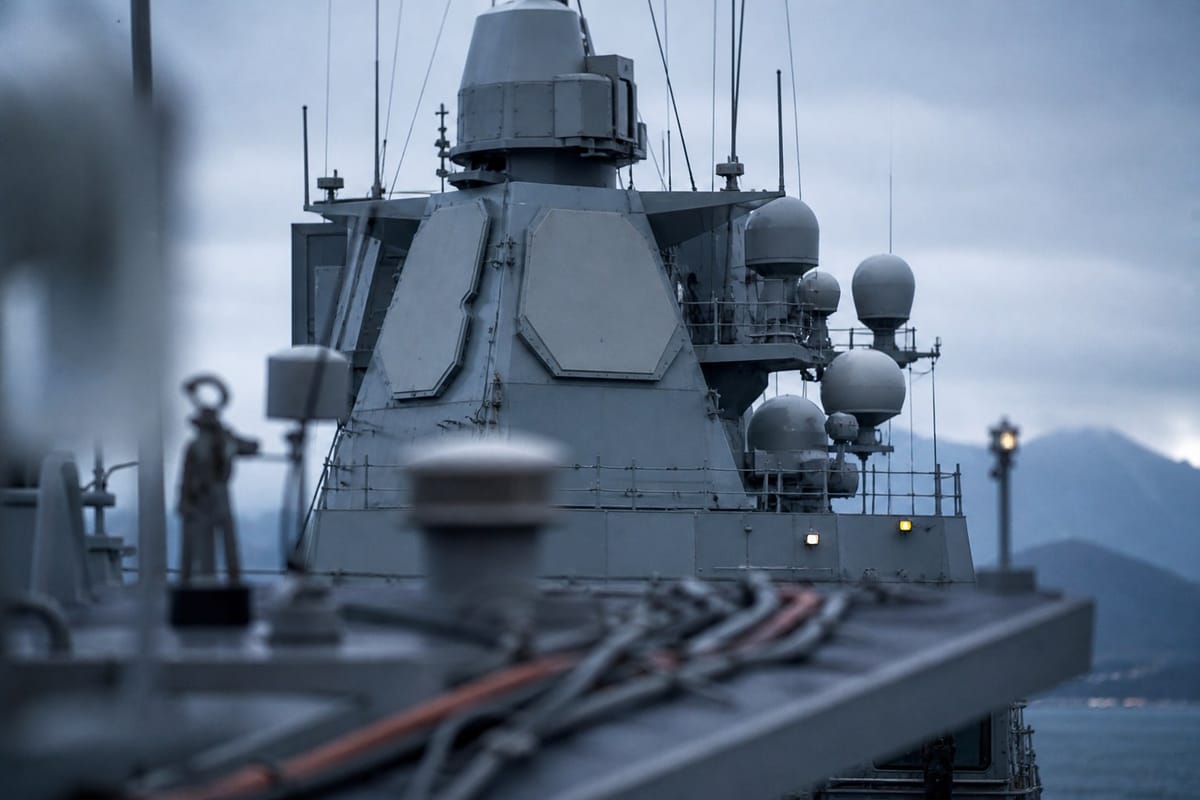
The Pentagon on Nov. 19 awarded 28 companies a combined contract worth up to $7,125,820,000 for the Navy's Surface Electronic Warfare Improvement Program, the family of systems built around the AN/SLQ-32 that protects surface ships from anti-ship missiles. The announcement covers work across firm-fixed-price, fixed-price incentive, cost-only, cost-plus-fixed-fee and cost-plus incentive-fee structures, drew 31 offers, and runs through November 2036 if all options are exercised.
The headline number deserves a careful reading. This is an indefinite-delivery, indefinite-quantity contract, and the guaranteed minimum for each of the 28 winners is $5,000, enough to fund a Program Management Plan and attendance at a post-award kickoff conference. The $7.1 billion is a ceiling that gets tapped only as the Navy places task orders. What the service actually bought on day one is access: a bench of 28 qualified suppliers it can place orders with through 2036.
The roster says something about how the Navy wants this market structured. Lockheed Martin (Liverpool, New York), Northrop Grumman Systems Corp. (Linthicum Heights, Maryland) and Raytheon Co. (Goleta, California) are on the list, alongside BAE Systems Technology Solutions & Services, CACI Inc. Federal, General Dynamics Information Technology, General Dynamics Mission Systems, HII Mission Technologies, Leidos, ManTech Advanced Systems International, Amentum Services, CAES Systems, Ultra Electronics Ocean Systems, VT Milcom, Aeronix, EWA Warrior Services and Laurel Technologies Partnership. Eleven of the 28 are flagged as small businesses, from Distributed Spectrum and Frequency Electronics in New York to PCI Aviation in Atmore, Alabama.
What the contract actually asks for
The solicitation behind the award, N00024-26-R-5504, was a full and open competition for Program Executive Office Integrated Warfare Systems, Above Water Sensors 2.0, and it spans five functional areas: build-to-print production at high, medium and low complexity, design agent engineering, and system integration for the AN/SLQ-32(V) family. That mix is the point. The Navy split the work so a shop that can only manufacture to print competes in a different lane than one that can redesign receivers or integrate a full suite onto a hull.
SEWIP has been built this way for a long time. The Navy established the program in 2002 to modernize the AN/SLQ-32 through incremental block upgrades, and Block 1 improved anti-ship missile defense, counter-targeting and counter-surveillance before Lockheed won the Block 2 contract in 2009 to upgrade the antenna, receiver and combat system interface. Block 2 reached full-rate production in September 2016, and Lockheed had produced more than 130 units as of October 2024, with the system on dozens of Arleigh Burke-class destroyers and headed for nearly all Navy surface combatants, both Littoral Combat Ship classes and the Coast Guard's Offshore Patrol Cutters.
Production is already flowing through the two primes
While the new IDIQ builds the bench, the money that actually moves today still runs through separate production contracts. On Sept. 30, 2026, Lockheed Martin Rotary and Mission Systems received a $208,962,712 firm-fixed-price modification under N00024-20-C-5503 for production of AN/SLQ-32(V)6 systems, with options that could bring the contract's cumulative value to $1,708,478,799. That work is 78 percent in Liverpool, New York and 22 percent in Lansdale, Pennsylvania, and is expected to be complete by September 2029. The October 2024 award that paired U.S. Navy purchases with a Japanese Foreign Military Sales buy, the first international sale of SEWIP, was structured the same way, as a modification to the standing full-rate production contract.
Northrop Grumman's Block 3 work follows the same pattern. A March 30, 2026 modification covers production of up to nine additional Block 3 systems, including the first shipset destined for an aircraft carrier, bringing Northrop's on-contract total to up to 24. Block 3, the AN/SLQ-32(V)7, adds a non-kinetic electronic attack, or soft-kill, capability on an open, software-defined architecture layered on top of the Block 2 electronic support system. The first Block 3 installation went aboard the destroyer USS Pinckney (DDG-91) in 2023, and Naval News reported that the Block 3 award was sole-source. Northrop is also developing Scaled Onboard Electronic Attack for ships that cannot support Block 3.
Read together, the two tracks show the Navy buying electronic warfare as a portfolio of production, engineering and integration tasks rather than as two prime franchises. The sole-source production lines keep proven Block 2 and Block 3 hardware shipping to the fleet. The 28-company IDIQ, with a $5,000 guarantee against a $7.1 billion ceiling, builds a supplier bench and keeps 28 companies qualified to compete before any task order is written. The real contest moves to the task-order level, where the Navy will decide, job by job, whether production volume, design-agent engineering or integration work goes to Liverpool, Linthicum Heights or one of the 11 small businesses on the list.