Boeing, Anduril, and Lockheed Martin Advance in the Race to Unburden Patriot
The Army selected Lockheed Martin and a Boeing-Anduril team for Phase 2 of its Second Interceptor competition, aiming to fill a critical mid-tier missile gap and preserve strategic Patriot stockpiles.
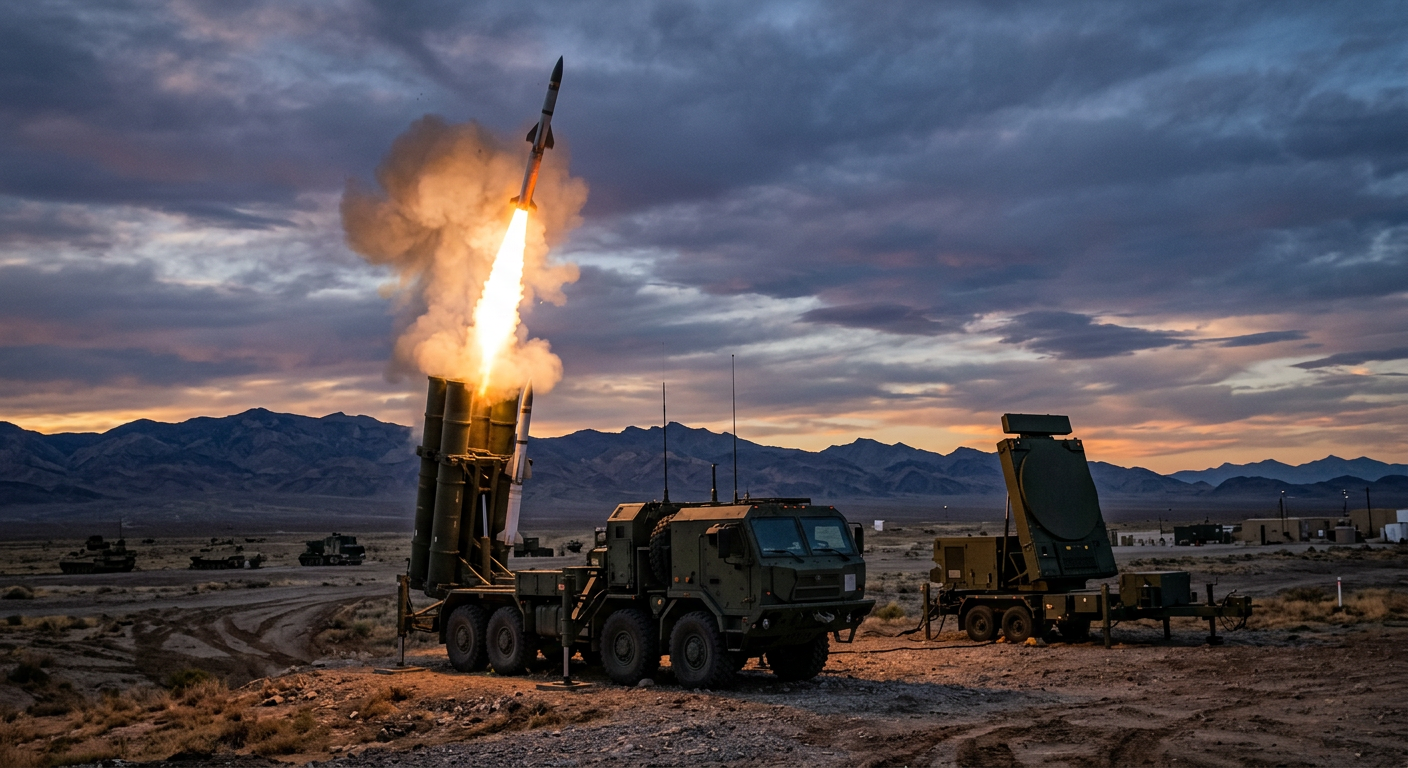
The U.S. Army selected Lockheed Martin and a joint Boeing-Anduril Industries team to advance to Phase 2 of the Integrated Fires Protection Capability Increment 2 Second Interceptor competition, narrowing a race to put a cheaper, longer-reach missile on the service's new ground launchers. Phase 2 covers detailed design, system development, integration, and a competitive live-fire flyoff against Army requirements. Rafael Systems Global Sustainment, the U.S. arm of Israeli contractor Rafael, was eliminated.
The down-select, disclosed in September 2026, marks a pivotal effort to solve the Army's air defense economics. For three decades, air defenders have jumped from short-range Stingers straight to Patriot PAC-3 MSE and THAAD, burning expensive interceptors on threats that should never have forced that choice. The remaining contestants must prove a mid-tier interceptor can fit Enduring Shield's 18-round pallet, defeat supersonic cruise missiles, and cost little enough to fire without exhausting strategic inventories.
Bridging the Post-Hawk Air Defense Chasm
The Army has lacked a dedicated mid-range air defense missile since retiring the MIM-23 Hawk in the 1990s, a gap The War Zone documented as both an operational and economic vulnerability. M-SHORAD covers the close fight, while Patriot and THAAD handle high-end ballistic threats. Between them sits a dangerous spectrum of cruise missiles and long-range attack drones that have depleted interceptor stockpiles across the Middle East and Ukraine. Firing multi-million-dollar PAC-3 MSE rounds at low-cost aerial threats has created an unsustainable consumption rate.
At the August 2026 Space & Missile Defense Symposium, Lt. Gen. John Rafferty, head of Army Space and Missile Defense Command, stressed severe magazine-depth shortfalls and the need for a cheaper, wider-ranging mix of interceptors. The launcher is already entering service: Dynetics, a Leidos subsidiary, secured a $617 million FY2026 production contract for Enduring Shield launchers and magazines. However, Enduring Shield currently fires RTX's infrared AIM-9X Sidewinder, which offers a range of roughly 10 miles (16 kilometers).
That short-range infrared envelope cannot defeat fast, low-flying cruise missiles at standoff distances. The Second Interceptor requirement, detailed in a Congressional Research Service report, calls for active radar guidance, supersonic cruise missile defeat capability, and kinematic reach comparable to an AIM-120D AMRAAM, all packaged into a compact airframe that preserves 18 missiles per launcher.
Two Radically Different Industrial Philosophies
Boeing and Anduril are combining traditional aerospace systems engineering with agile solid propulsion. Boeing provides seeker technology, precision engagement, and Modular Open Systems Architecture (MOSA), while Anduril supplies solid rocket motors through Anduril Rocket Motor Systems. In a company feature, Bob Ciesla, vice president of Boeing Precision Engagement Systems, emphasized a scalable production approach designed for high-rate manufacturing, with MOSA enabling seeker and software swaps without full missile redesigns.
Lockheed Martin's Missiles and Fire Control division is countering with deep hit-to-kill heritage, drawing on its PAC-3 MSE lethality enhancer technology and compact air-to-air concepts like Cuda. Defense Daily confirmed Lockheed's selection for the demonstration phase. Where Boeing-Anduril highlights modularity and rapid scaling, Lockheed offers proven missile manufacturing maturity and seamless integration with the Army's Integrated Battle Command System.
Phase 2 will force both teams to validate their kinematics in live-fire testing against complex target profiles. With Rafael out of the running, the Army's mid-tier future rests entirely on these two competing manufacturing approaches.
Guam, Magazine Depth, and the 2027 Deadline
Army procurement budgets are accelerating ahead of missile development. The service requested $1.6 billion for IFPC Increment 2 in FY2027, nearly doubling its $831 million FY2026 allocation, according to the CRS report. Second Interceptor development will run through 2029-2030 before entering low-rate initial production, supporting nine planned battalions through FY2033. In the near term, 20 Enduring Shield launchers will deploy to Guam in FY2027 as part of a composite Patriot battalion.
This deployment schedule highlights the operational urgency. Guam will receive launchers armed with short-range AIM-9X missiles years before the Second Interceptor reaches initial fielding, leaving Patriot as the primary defense against long-range cruise missiles in the interim.
The competition between Lockheed Martin and the Boeing-Anduril team will decide how quickly the Army closes that gap. Delivering a high-rate, compact, active-radar interceptor is essential to providing the magazine depth air defenders need while reserving Patriot for the strategic missions it was built to handle.