The Navy's New Shipbuilding Model Just Handed Its First Award to a South Korean Giant
Hanwha will build a $269 million Marine Corps landing ship in Philadelphia, the first yard selected under a new Navy construction-manager model that cut the time to contract by nearly half.
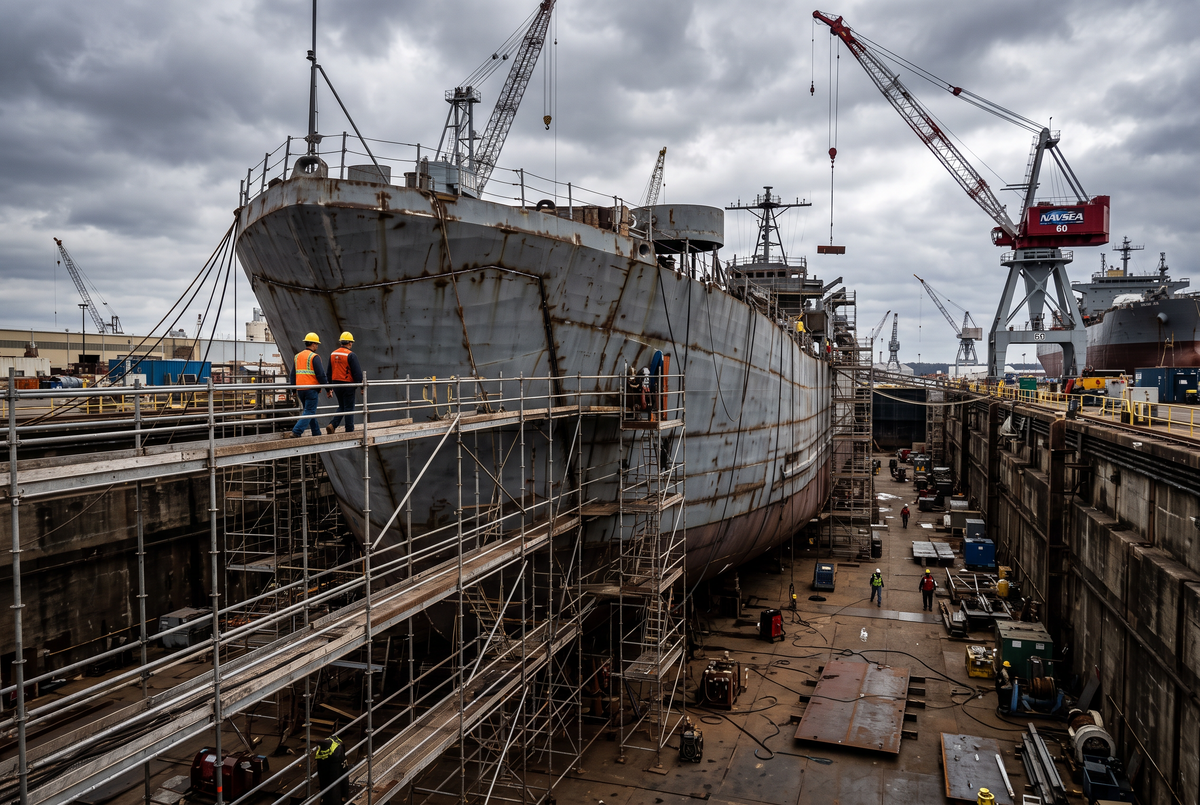
Hanwha Defense USA now has its first U.S. Navy shipbuilding contract, and the service bought it through a commercial middleman it has never used to run a ship program. TOTE Services, the vessel construction manager for the Marine Corps Medium Landing Ship, announced on Oct. 30, 2026 that Hanwha will build one LSM at Hanwha Philly Shipyard for $269 million, with options for three additional vessels. Construction of that first hull can start in the fourth quarter of 2027.
The Philadelphia award is the opening competitive pick, not the program. TOTE holds a $2.2 billion vessel construction manager contract to assemble a planned 35-ship LSM fleet for the Navy and Marine Corps. For initial production of up to eight ships, the Navy directed the manager to work with Bollinger Shipyards on one LSM and Fincantieri Marinette Marine on four, and left the manager free to choose the award strategy for up to three more. Hanwha's $269 million hull is one of those extra slots, with options that could put three more LSMs on the same Philadelphia ways.
A commercial manager, a faster clock
A USNI News report put the novelty in plain terms: this is the first time the Navy has used a vessel construction manager to run a ship program. Instead of contracting a yard itself, the service hired a commercial construction manager, told that manager to select builders, and kept a common design so multiple yards could produce the same class. The LSM is based on Damen's LST-100. The Navy bought that design package for $17 million. Last year the White House also announced a trade deal with South Korea that included a South Korean pledge to put $150 billion into American shipbuilding, the political weather around a Korean-owned yard taking Navy work, not the contract itself.
The contracting clock is the operational argument for the model. A Navy release said the VCM path went from RFP to award in five months, a nearly 50 percent reduction from traditional contracting timelines, according to Will Mahan, the acting assistant secretary of the Navy for research, development and acquisition. First LSM delivery is expected in fall 2029. The ship fills the gap between smaller short-range landing craft and the Navy's large amphibious ships, so Marine units can maneuver and sustain themselves in a contested environment without tying every lift to a big-deck amphib.
A 35-ship class only exists if the industrial base can actually cut steel on a calendar the Marines can use. Traditional Navy ship contracts often spend as much time in source selection as in early production. The VCM structure is an attempt to borrow a commercial construction-manager method, already familiar from Maritime Administration work, and run several yards in parallel under one program manager instead of sequential, yard-by-yard Navy buys.
Philadelphia after the Aker sale
Hanwha Group completed its roughly $100 million acquisition of Philly Shipyard in December 2024, buying the yard from Norway's Aker ASA and renaming it Hanwha Philly Shipyard. The buyer is a South Korean industrial conglomerate. What changed in October is that a Navy landing ship is now on that yard's books.
The shop is not starting cold. Hanwha Philly previously built and delivered four National Security Multi-Mission Vessels for the U.S. Maritime Administration under the VCM model with TOTE Services. That existing manager-and-yard relationship is the immediate reason TOTE could place an LSM in Philadelphia. The design is not Hanwha's. Common drawings across Bollinger, Marinette, and Philadelphia are how a construction manager is supposed to keep a 35-ship class from becoming three different ships with three different problems.
It is also the wrong frame to treat this as a unique foreign-owned foothold in Navy construction. Fincantieri Marinette Marine is already on the LSM plan for four hulls. Hanwha's claim is narrower, and more precise: this is the conglomerate's first U.S. Navy shipbuilding contract, and Hanwha is the first shipbuilder selected through the new VCM competitive process.
Thirty-five ships, most of them still unplaced
TOTE has said additional shipyard selections are planned. Bollinger and Fincantieri already have directed work. Hanwha has the first competitive award and options on three more hulls. The rest of a 35-ship fleet is still a requirement on paper until more yards are named and more options are exercised. Fall 2029 is the Navy's first-delivery mark. Steel in Philadelphia is not scheduled to start until the fourth quarter of 2027. That gap is where a faster contract either becomes a faster ship or just a faster piece of paper.
The money on this award is real, and so is the competitive position. Two hundred sixty-nine million dollars buys one LSM, not a fleet, and the options only matter if the Navy pulls them. What the October selection does change is who is inside the program. A South Korean conglomerate has entered U.S. naval shipbuilding through a commercial-style acquisition model that cut the Navy's contracting timeline by roughly half, and more yard selections are coming.