How Northrop Grumman Locked In a Decade of Laser Defense for U.S. Army Helicopters
The U.S. Army awarded Northrop Grumman a $4.84 billion contract for Common Infrared Countermeasure systems through 2035, cementing a sole-source transition from pyrotechnic flares to continuous laser jamming across its combat helicopter fleet.
The U.S. Army locked Northrop Grumman into a decade of helicopter self-protection work. On September 8, 2026, the Department of Defense announced that Northrop Grumman Systems Corp. of Rolling Meadows, Illinois, won a $4,838,487,318 firm-fixed-price, indefinite-delivery/indefinite-quantity contract for full-rate production of the Common Infrared Countermeasure system. The award, W58RGZ-26-D-0056, runs through September 30, 2035, and is managed by Army Contracting Command at Redstone Arsenal, Alabama. It was a sole-source buy: one bid solicited, one received.
That $4.84 billion ceiling is the Army's commitment to make CIRCM the standard directional infrared countermeasure for combat rotorcraft through the mid-2030s, replacing expendable magnesium flares with a laser that fires as long as the aircraft has electrical power.
Why flares are running out of time
CIRCM is the Army's fleetwide answer to heat-seeking missiles, especially shoulder-fired MANPADS that threaten helicopters at low altitude. Traditional pyrotechnic flares burn out in three to five seconds and empty finite dispenser magazines in high-threat combat. Modern dual-band and imaging infrared seekers can also filter those decoys. CIRCM takes a different approach: an active, continuous laser architecture that jams the missile instead of trying to outshine it.
When an onboard missile warning system (BAE Systems' AAR-57 Common Missile Warning System or Northrop's ATHENA sensor) detects an incoming plume and hands off azimuth and elevation, CIRCM's compact dual pointer-trackers slew in seconds, lock onto the threat, and fire modulated quantum cascade laser energy from Leonardo DRS Solaris and Jupiter lasers into the seeker's optics. The effect is break-lock jamming: the missile loses optical lock and is steered off the aircraft. Because the system draws electrical power rather than cartridges, it can meet repeated or simultaneous launches without running out of ammunition. Forecast International described that shift as the industrial logic behind the new multi-year buy.
CIRCM also replaced the older, heavier Advanced Threat Infrared Countermeasures suite. The Army moved the program into full-rate production with a five-year IDIQ in April 2021 (W58RGZ-21-D-0028) that started at a $959.1 million ceiling, later adjusted to $998.2 million. By 2026 that vehicle had obligated more than $904 million, according to a GovConWire account of the earlier production run. The 2026 award turns a completed fielding campaign into a ten-year production franchise.
A fleet already flying on laser jamming
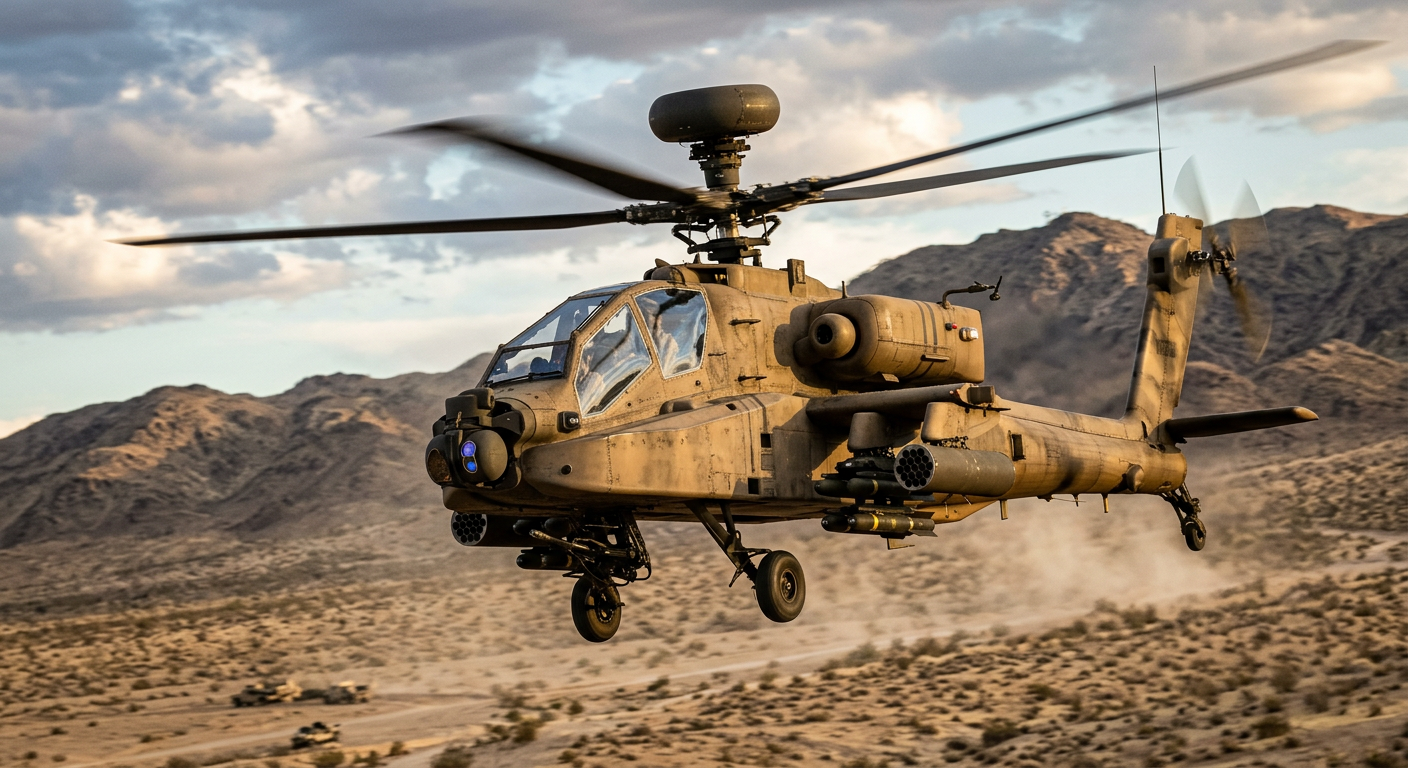
The new IDIQ is not buying an unproven kit. CIRCM is already fielded on the Army's primary combat helicopters: the AH-64E Apache, the UH-60M and HH-60M Black Hawk, and the CH-47F Chinook. Northrop Grumman has delivered more than 750 CIRCM shipsets and logged more than 75,000 operational flight hours. Those numbers matter for a sole-source follow-on. The Army is buying more of the system already riding on attack, utility, and heavy-lift airframes.
That installed base explains the contract structure. A firm-fixed-price IDIQ through 2035 lets Redstone Arsenal place production orders as airframes cycle through reset, new-build lots, and attrition replacements without reopening a competition every year. For Northrop, Rolling Meadows becomes the durable CIRCM production node for the rest of the decade. For the Army, the industrial risk of a second DIRCM vendor is traded for continuity on a system with proven fleet hours.
The $4.84 billion figure represents purchasing authority across a nine-year horizon rather than immediate booked revenue. IDIQ vehicles authorize orders up to that ceiling through September 30, 2035. Actual deliveries will track helicopter production, recapitalization, and FMS cases over time. The strategic signal remains clear: infrared self-protection for Army rotorcraft is now an active laser production line rather than a flare magazine constraint.
FLRAA and the allied order book
The 2026-2035 vehicle also positions CIRCM as the baseline infrared defense for Future Vertical Lift. The Future Long Range Assault Aircraft, designated the Bell MV-75 tiltrotor and expected in service in the 2030s, is slated to carry CIRCM as the standard suite rather than an add-on. That matters because FLRAA is built to fly farther and faster than today's assault helicopters. A continuous laser jammer that does not consume decoy stores fits long-range assault profiles better than a finite flare load.
Allied demand is moving the same direction. Germany has ordered CIRCM for its CH-47 Chinook fleet, and the Netherlands and Australia have shown interest, according to the same Forecast International report. Those FMS cases sit on top of the U.S. Army production line rather than replacing it. A common DIRCM across allied Chinooks also simplifies training, spares, and coalition operations in theaters where MANPADS remain a first-day threat.
After Ukraine and the broader proliferation of cheap, portable air defenses, Western militaries are treating helicopter survivability as an enduring industrial program, not a kit bag of flares. Northrop Grumman's sole-source CIRCM award through 2035 is the Army's bet that a compact quantum cascade laser, already flying on Apache, Black Hawk, and Chinook, is the architecture to protect FLRAA and allied fleets. The $4.84 billion ceiling provides the procurement foundation for that strategy.