The Air Force Put 58 Companies on One Engine Contract. Two Have Supplied Its Fighters for Decades.
The Air Force named 58 companies to a propulsion contract with a $16.1 billion ceiling and obligated $1,000 per company. In August it had asked industry for alternatives to the engines that power its F-15s and F-16s.
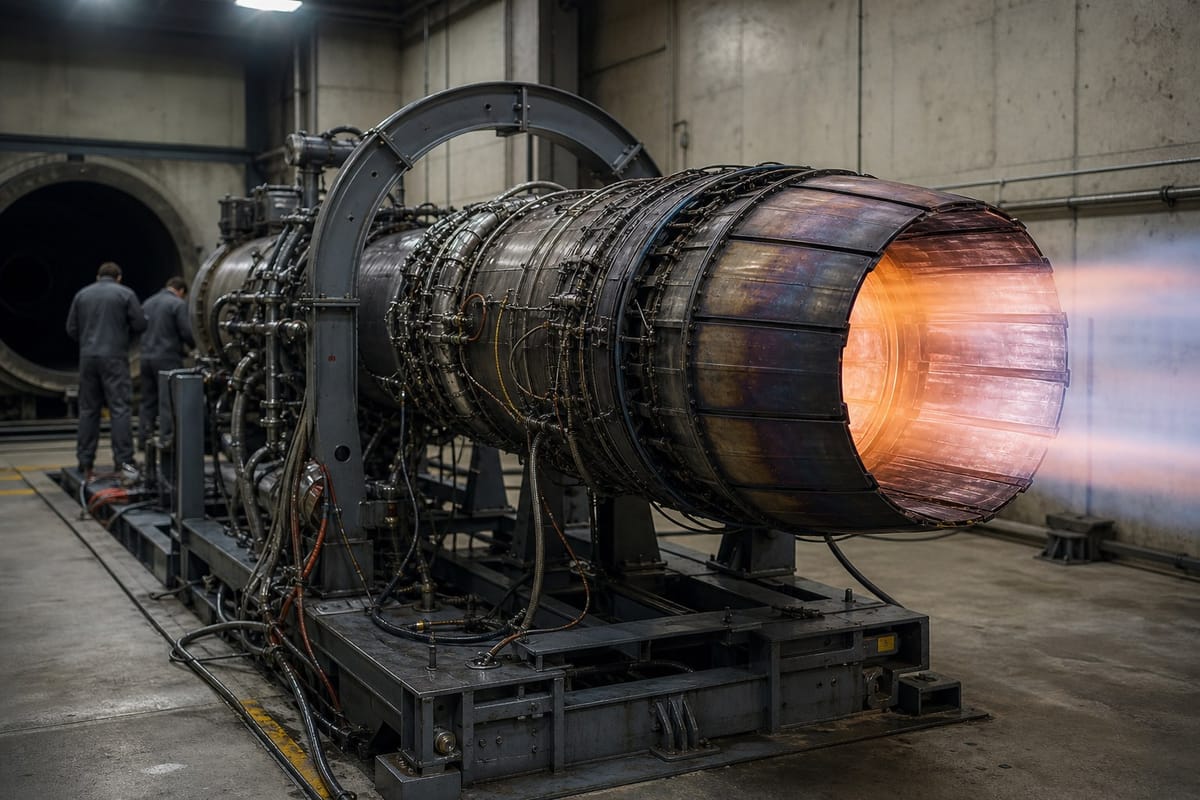
The Air Force has powered its F-15 and F-16 fleets with engines from two companies for decades. On Nov. 20 it awarded a propulsion contract with a $16.1 billion ceiling to 58 companies and obligated $58,000 at award, or $1,000 per company.
The vehicle is an indefinite-delivery/indefinite-quantity contract, which means the ceiling describes the most the government could spend rather than money set aside. Naming 58 awardees in advance builds a standing pool: when the service wants propulsion work done, it can issue a task order to a company already inside the vehicle instead of running a fresh competition for each requirement. The notice says the arrangement "provides for the continuing enhancement of propulsion technology across all areas and lifecycle phases of propulsion development," and that the awards "were competitive acquisitions." Work is expected to run to November 2041, with Air Force Material Command at Wright-Patterson Air Force Base in Ohio as the contracting activity.
The money attached so far is thin. Breaking Defense reported that the Air Force is "not necessarily obligated to spend the full amount," and cited a March notice stating the service had not yet secured funding for the initiative and would not issue contracts until it did. Asked about the contract's funding and expected scope, the Air Force did not immediately respond.
A Base the Service Already Called Fragile
The vehicle landed on top of a problem the Air Force had described itself. In August it issued a Request for Information on alternative engines for the F-15EX and F-16, warning that "the current industrial base has demonstrated significant challenges, including production delays, quality control issues, and critical obsolescence (i.e., diminishing manufacturing sources and material shortages) across key engine components." Responses were due Aug. 28. The document outlined a multiyear fighter engine procurement program of more than 180 engines a year by 2034, a "strategic competition requiring industry to innovate manufacturing and guarantee supply chain resiliency," and a shift toward "the total lifecycle cost of the engine, not just the initial purchase price."
Two Engine Families, Two Claims
Both fighters draw on engines whose makers describe them in their own terms. GE Aerospace states that the F110 is "the only certified, in-production engine that powers every Advanced F-15 in service today, including the F-15EX," with more than 3,800 engines delivered, 18 nations that have selected it, and more than 40 years of continuous production. Pratt & Whitney, part of RTX, states that its F100 engines "have powered the F-15 for more than 50 years and the F100-PW-229 is fully capable of integrating with the F-15EX," and that more than 3,800 F100 engines serve in 23 air forces around the world. Those are company claims about their own products, not findings the Air Force has published.
The contract type is not new to this market. In March 2025, GE Aerospace announced an Air Force IDIQ valued at up to $5 billion for Foreign Military Sales of the F110-GE-129, the engine behind allied F-15 and F-16 fleets. What changed in November is the breadth of the pool.
Six names on the list are established propulsion manufacturers: General Electric, RTX, Rolls-Royce North American Technologies, Honeywell International, Williams International and Aerojet Rocketdyne. Lockheed Martin, Northrop Grumman and Boeing appear as primes, alongside Safran Defense & Space and Bet Shemesh Engines of Israel. A separate cluster of names sits further down: Hermeus, Beehive Industries, Mach Industries, Astro Mechanica, Whisper Aero, Jetoptera. The rest reads like a supply chain, with Sintavia in additive manufacturing, Ozark Integrated Circuits in electronics, Florida Turbine Technologies in turbine engine development, Standard Aero in maintenance, Southwest Research Institute and Dynetics in research and integration, and Booz Allen Hamilton as a consultant. That spread is evidence of what the vehicle covers, not of any particular plan for how it will be used.
The Test Is Task Orders
A framework with 58 pre-qualified companies and $58,000 obligated can sit unused for years. What would show this one is real is a task order carrying substantial money against a named engine or component, or a fighter engine program that actually moves to a second source. Until then the ceiling is a number in a notice, and the two companies that have powered these fighters for decades are still the two companies that power them.