The Army's $45 Billion Bradley Replacement Race Just Moved From Digital Twins to Steel
General Dynamics Land Systems delivered its first physical XM30 Wolf prototype to Aberdeen Proving Ground, Maryland in late August 2026. The milestone advances a head-to-head $45 billion competition against American Rheinmetall to replace the M2 Bradley.
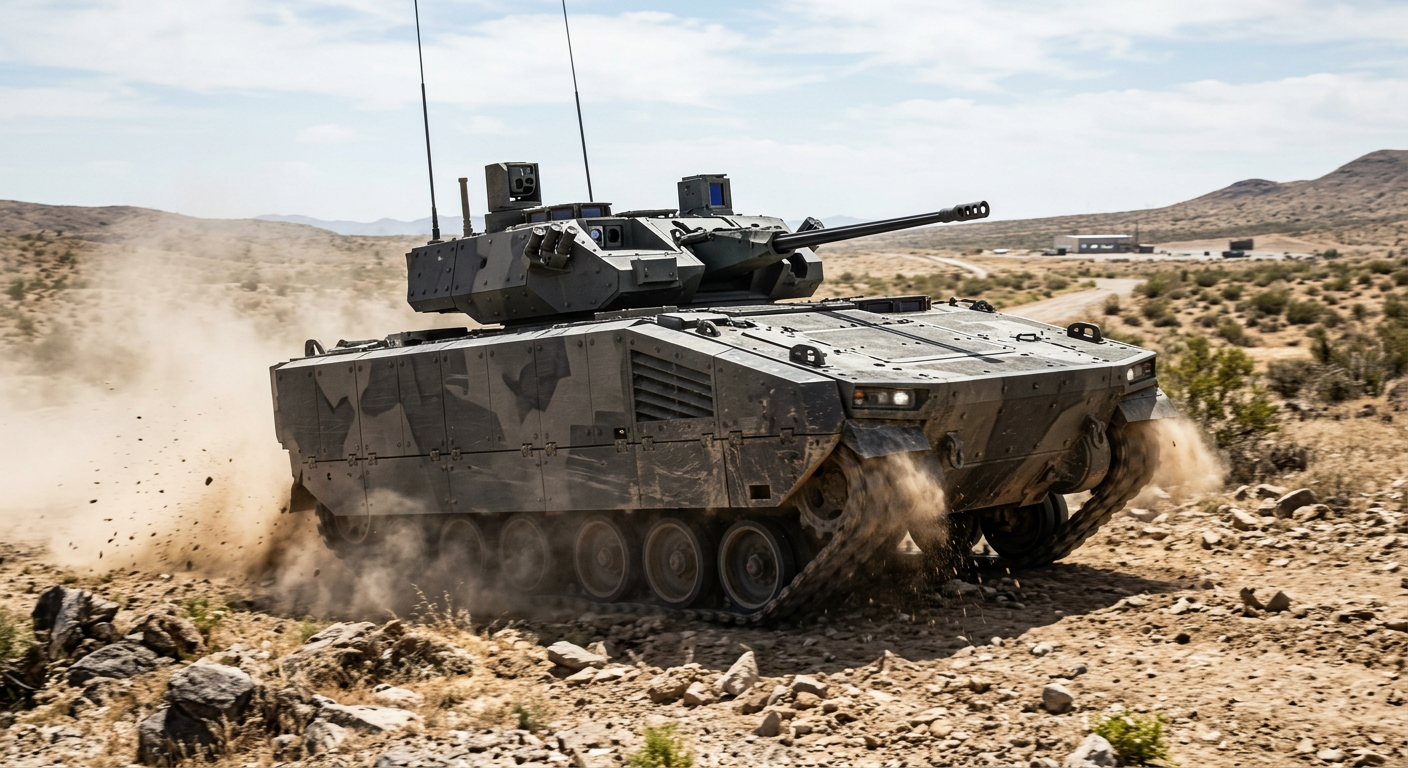
The U.S. Army's four-decade effort to replace the M2 Bradley Fighting Vehicle has officially transitioned from digital computer models into heavy armor and steel. In late August 2026, General Dynamics Land Systems delivered the first physical prototype of its XM30 Wolf Mechanized Infantry Combat Vehicle to Aberdeen Proving Ground in Maryland. Retired Brig. Gen. Geoffrey Norman, director of U.S. strategy and growth at GDLS and former head of the Next Generation Combat Vehicles Cross-Functional Team, confirmed the handoff as government acceptance testing begins.
The delivery marks a critical turning point for an Army modernization program that has suffered multiple cancellations since the 1980s. Previous attempts to replace the Bradley, including the Future Combat Systems Manned Ground Vehicles and the Ground Combat Vehicle, collapsed before soldiers ever tested complete physical prototypes. This time, the service structured the competition to carry two vendors through detailed design and extensive physical trials before making a final production choice.
A $45 Billion Fleet Recapitalization
In June 2023, the U.S. Army Contracting Command awarded combined Phase 3 detailed design and Phase 4 prototype build-and-test contracts totaling approximately $1.6 billion. The service split the award between General Dynamics Land Systems, which secured a $768.7 million firm-fixed-price contract, and American Rheinmetall Vehicles. The ultimate prize is an estimated $45 billion manufacturing program to recapitalize an infantry fighting vehicle fleet spanning 2,500 to 4,000 vehicles across active and reserve formations.
The industrial contest pits the incumbent land-systems prime against a formidable challenger consortium. General Dynamics manufactures the Army's legacy M1 Abrams and Stryker fleets, leveraging an assembly network across Sterling Heights and Grand Rapids in Michigan, Lima in Ohio, Scranton in Pennsylvania, Tallahassee in Florida, and London in Ontario. American Rheinmetall readies its Lynx XM30 with Team Lynx partners Textron Systems fabricating hulls in Slidell, Louisiana, alongside RTX Raytheon, L3Harris Technologies, Allison Transmission, and Anduril Industries.
Stepping Beyond Cold War Margins
The Bradley has anchored mechanized infantry formations since 1981, but four decades of armor and electronics additions have exhausted its electrical generation, weight, and cooling margins. The XM30 requirement represents a fundamental generational leap in vehicle design and lethality rather than another incremental upgrade.
Both offerings replace the Bradley's legacy 25mm M242 Bushmaster with a 50mm XM913 automatic cannon firing a newly developed family of XM1202 Target Practice-Tracer, XM1203 armor-piercing, and XM1204 programmable high-explosive airburst munitions. Both designs utilize a remotely operated unmanned turret, placing the two-soldier crew down inside the heavily armored chassis while carrying six dismounted infantry in the rear compartment. Integrated hybrid-electric powertrains deliver silent maneuver capability alongside exportable electrical power to drive 360-degree digital vision, high-performance compute, electronic warfare, and active protection systems.
The designs also integrate organic loitering strike weapons: GDLS incorporates AeroVironment Switchblade 300 munitions into the Wolf, while Rheinmetall integrates Raytheon Coyote drones and Javelin anti-tank missiles onto the Lynx.
The Road Through Fort Cavazos and NTC
Each contractor is under contract to deliver seven to 11 complete physical prototypes alongside ballistic test hulls and armor coupons. Following initial automotive and survivability checks at Aberdeen Proving Ground, seven GDLS Wolf prototypes and competing American Rheinmetall Lynx vehicles will ship to Fort Cavazos, Texas.
There, soldiers from the 1st Armored Brigade Combat Team, 1st Cavalry Division, known as the Iron Horse Brigade and commanded by Col. Todd Hertling, will conduct rigorous operational evaluations. Testing will culminate in a combined-arms desert rotation at the National Training Center in Fort Irwin, California, where XM30 prototypes will maneuver alongside next-generation M1E3 Abrams tank prototypes to assess crew workload and tactical agility under realistic battlefield conditions.
The Army plans to select a single winning vendor in late 2027 or fiscal 2028 for Phase 5 Low-Rate Initial Production covering up to 19 vehicles, targeting first unit fielding in fiscal 2029 and full-rate production around 2030. Program Acquisition Executive for Maneuver Brig. Gen. Troy Denomy emphasized that maintaining dual-vendor competition remains a core priority as long as appropriations allow. With the first physical Wolf now on government testing grounds and Lynx prototypes following behind, the race to build the next backbone of American mechanized warfare is finally underway.