The Dry Dock Defueling Backlog Trapping 15 Nuclear Submarines at the Pier
A new GAO report finds the Navy will spend $3.1 billion keeping 15 retired attack submarines manned and fueled because public and private dry docks have no room to defuel them. The same yards already burned $3.4 billion on active boats that sat idle for a decade.
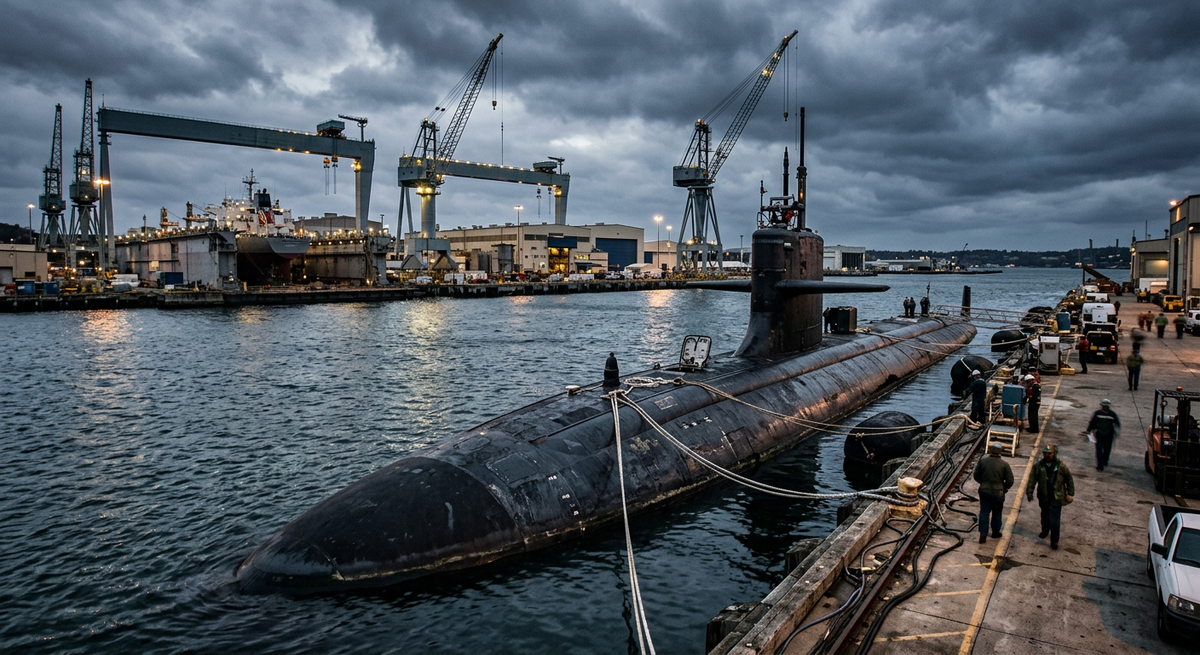
Combatant commanders still want every attack submarine they can get in the Indo-Pacific. The industrial system that is supposed to keep those boats at sea is instead holding a growing pile of retired hulls at the pier, reactors still fueled, crews still assigned, meters still running. That is the quieter finding in the Government Accountability Office's August 27 report on Navy attack submarine maintenance (GAO-26-109256), the unclassified version of a classified July study requested under House Report 118-529.
The Navy entered fiscal 2025 with 44 attack submarines. Over the decade from FY2016 through FY2025, maintenance backlogs and what auditors call active idle time cost the fleet more than 15,000 operational days, or 41 ship-years. Those delays produced $3.4 billion in sustainment costs for boats providing zero operational capability, with Los Angeles-class hulls carrying most of the bill and Virginia-class boats adding hundreds of millions more. Every day an attack submarine sits pierside waiting for depot work costs taxpayers about $230,000. New Virginias arrive at roughly one boat a year against the Navy's requirement of two, squeezed by labor competition and supplier delays. The force is shrinking on the way in and clogging on the way out.
The exit ramp is the new bottleneck
Auditors credit the Navy with modest progress against active maintenance delays, but the worse problem has moved to the end of the service life. Between FY2026 and FY2030, 15 attack submarines, predominantly Los Angeles-class boats, will hit retirement and drop into inactive idle status. Public shipyards at Norfolk, Portsmouth, Puget Sound, and Pearl Harbor, alongside private yards at General Dynamics Electric Boat and Huntington Ingalls Newport News Shipbuilding, are packed with operational overhauls and new construction for Columbia-class and Virginia-class submarines. There is no dry dock left to defuel the reactors of retired boats.
Over those five years the 15 retired hulls will accumulate more than 14,000 days of inactive idle time. The Navy will spend $3.1 billion in operating and support funding just to sustain and monitor them while they wait for a defueling slot. That is a carrying cost on assets that have already left the fight.
Pasadena's 1,414-day wait
USS Pasadena (SSN 752), a Los Angeles-class submarine, entered inactive idle status on January 1, 2025. Shipyard capacity constraints mean it will not enter Norfolk Naval Shipyard for defueling and inactivation until November 15, 2028, a 1,414-day layover. Because the reactor remains fueled, the Navy cannot lock the hatch and walk away. Pasadena must stay fully manned with trained nuclear sailors. The wait will cost more than $300 million.
The precedent is USS Boise (SSN 764). Years of shipyard delays put $1.6 billion into repairs before the Navy moved to decommission the boat. Chief of Naval Operations Adm. Daryl Caudle called that outcome unacceptable. Pasadena shows the same industrial bind from the other direction: a hull taken off the operational board, still consuming nuclear-trained sailors and sustainment dollars because the defueling dock does not exist on the calendar.
Waterborne defueling and a thinner watch
GAO's recommendations are blunt. The Navy should evaluate alternative decommissioning methods, including waterborne defueling outside dry docks, and explore reducing crews assigned to inactive boats. It should also formalize an attack submarine inactivation plan. The service verbally concurred.
Waterborne defueling would attempt to pull spent fuel without occupying a scarce graving dock. Smaller inactive crews would free nuclear-qualified sailors for boats that still deploy. Neither fix is free of risk. A fueled reactor pierside must be watched to a nuclear standard, and defueling outside a dry dock faces a stringent safety case. The alternative is the status quo: 15 hulls, 14,000 idle days, $3.1 billion, and a manpower drain the fleet cannot spare.
Industrial base money does not empty the pier
Congress has poured billions into the submarine industrial base to lift Columbia and Virginia throughput. That spending is aimed at the front of the line, but it does not create defueling capacity at the back. As long as the same docks are booked for new construction and operational overhauls, retired attack boats remain a fueled, manned inventory problem. The GAO analysis makes the trade explicit. Inactive idle time is set to cost $3.1 billion, while tying up the nuclear personnel and infrastructure the high-readiness force needs.
The attack submarine fleet is the Navy's most requested undersea asset and one of its hardest to cycle. Until inactivation is treated as a scheduled industrial output rather than a residual after Columbia and Virginia take the docks, the queue at the pier will keep growing, and the bill will keep landing on boats that no longer go to sea.