The Navy's Robotic Warships Are Going Into Production in Oilfield Country
The Navy is putting 30 robotic warships into production in Louisiana, splitting the work among Galliano, HII, and startup Saronic instead of the primes' mega-yards.
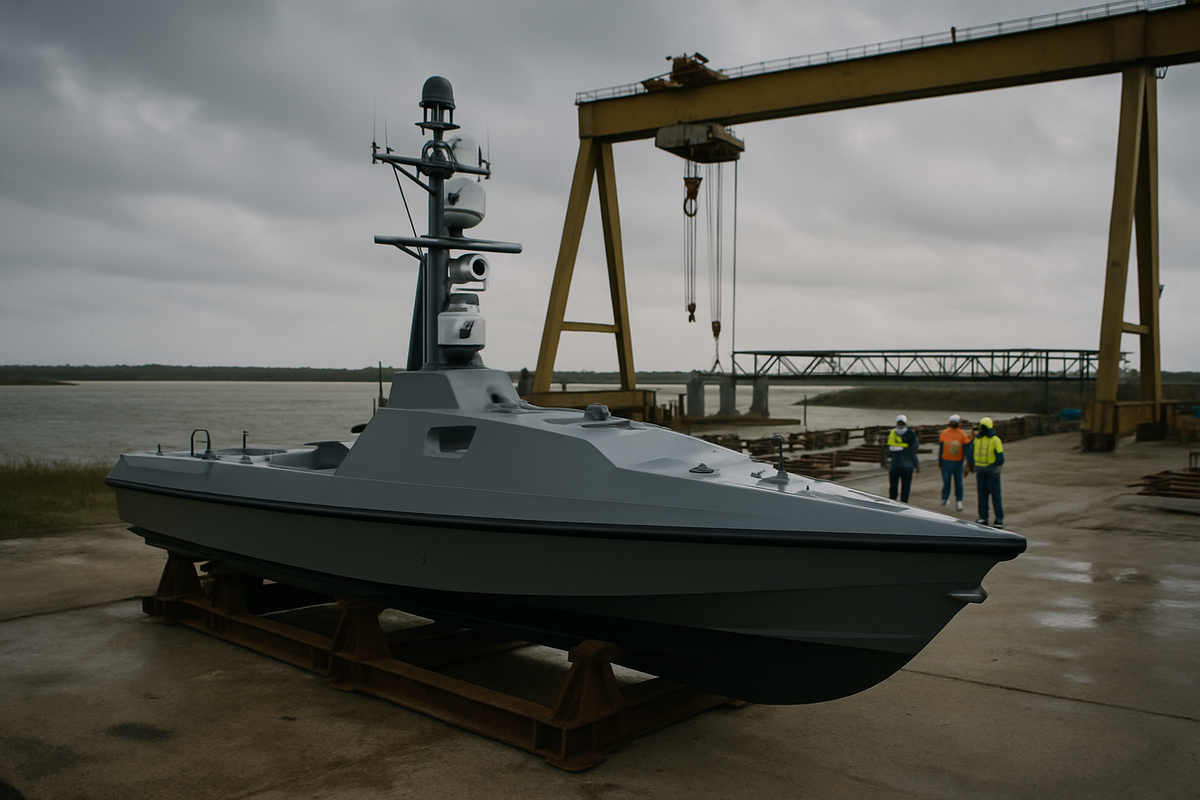
The U.S. Navy is taking its Medium Unmanned Surface Vessel program out of testing and into a first production run, and the hulls are coming from Louisiana oilfield country. On Sept. 29, 2026, the service announced plans to procure 30 MUSVs after completing Phase I at-sea testing, awarding production Other Transaction Authority agreements to Galliano Marine Services, HII, and Saronic Technologies.
Each company will build 10 vessels at an average procurement cost of $40 million per hull, according to the same release. The Navy did not disclose a per-company dollar amount. Thirty hulls at that unit cost would come to about $1.2 billion in total, an arithmetic inference rather than a figure the service stated.
Production begins immediately at shipyards in Loreauville, Houma, and Franklin, Louisiana, with deliveries starting as early as the fourth quarter of Fiscal Year 2027, according to Chris Miller, the Navy's acting direct reporting portfolio manager for robotic and autonomous systems, as USNI News reported. The split puts a Houma-based marine-services and shipbuilding company, America's largest military shipbuilder, and a defense-tech startup valued at about $9.25 billion in a March funding round into the same production cohort.
A hedge the Navy can put at risk
Acting Secretary of the Navy Hung Cao framed the awards as a speed problem as much as a hull problem. "Our warfighters don't have time to wait on bureaucracy while our adversaries pace forward... build fast, deliver on time, and match the urgency of the threat," he said.
The Chief of Naval Operations describes MUSVs as part of the Navy's "hedge strategy" and a "Tailored Offset" of capacity that can be placed at risk without placing Sailors at unnecessary risk, per that release. The unmanned boats are meant to add mass that can be sent forward without putting a crew on the deck.
Phase I required a vessel able to travel 2,500 nautical miles at 25 knots in sea state 4 while carrying up to 25 metric tons of payload across at least two 40-foot shipping containers, USNI News noted. With that bar cleared, the first production MUSVs are scheduled for delivery before the end of Fiscal Year 2027, the Navy said.
Oilfield yards, a startup, and a prime's partners
Galliano Marine Service, which also does business as Edison Chouest, is based in Houma, Louisiana, USNI News reported. The Houma company is an offshore-energy-services and shipbuilding shop now taking 10 Navy MUSVs, a production role the manned fleet has long reserved for the primes' mega-yards.
Breaux Brothers Enterprises, partnered with HII, is in Loreauville in Iberia Parish. HII also works with Halimar Shipyard of Morgan City on its ROMULUS MUSVs, the same outlet said. Saronic is building in Franklin, Louisiana, at a yard formerly known as Gulf Craft that the company has spent hundreds of millions of dollars to expand, per that account.
Saronic closed a $1.75 billion Series D at a $9.25 billion valuation in a March 2026 funding round. The defense-tech startup is now one of three builders on the Navy's first MUSV production run, working from the same stretch of the Gulf coast as Edison Chouest.
HII is building where the bayou yards already are
HII describes itself as America's largest military shipbuilder and the largest producer of unmanned underwater vehicles for the U.S. Navy. In July 2026 it added Halimar Shipyard in Morgan City to its ROMULUS production network. As of that announcement, five ROMULUS 151 vessels were under construction at Breaux Brothers Enterprises in Louisiana.
HII's ROMULUS production partners include Breaux Brothers, Halimar, and Bayou Metals, with design partner Incat Crowther of Sydney, the company said. ROMULUS is HII's modular family of AI-enabled unmanned surface vessels for intelligence, surveillance, and reconnaissance, mine countermeasures, strike, counter-UAS, and launch and recovery of unmanned underwater and aerial vehicles.
On Oct. 27, 2026, HII will host a production celebration and hull plaque dedication for the first-in-class ROMULUS 151 at Breaux Brothers in New Iberia, Louisiana, with Louisiana Governor Jeff Landry and HII CEO Chris Kastner. The event, coming roughly a month after the awards, underlines where the prime has chosen to cut steel: at a small Louisiana partner, not at its own mega-yard.
Prototype teams stay in the marketplace
The production awards do not close the door on the Phase I shops. Leidos, PAC MAR, and Sea Machines completed their prototype Other Transaction agreements and each receive a $15 million award and entry onto the Drones.mil Maritime Marketplace, the Navy said.
That marketplace path keeps the prototype builders in the unmanned surface mix even as Galliano, HII, and Saronic take the 30-hull production run. For a Navy trying to grow unmanned capacity without putting sailors on the line, the shift that matters is who gets to build. The first production MUSVs will come from Houma, Franklin, Loreauville, and the small yards around them, not from the primes' mega-yards.