The Pentagon's Next Missile Trackers Must Hold a Hypersonic Missile From Launch to Impact
The Space Development Agency is asking industry how to keep fire-control-quality custody of a maneuvering hypersonic missile for its entire flight. Tranche 4 production and on-orbit demos will follow a December 4 deadline.

The Space Development Agency has begun shopping for the harder half of missile tracking. The satellites already built and on order are strongest at spotting a launch and watching a largely predictable arc. The job now on the table is one they still do not fully do: keep a continuous, fire-control-quality track on a maneuvering hypersonic missile or cruise missile for the entire flight.
On October 20, the agency posted a request for information on enhancements to its baseline Tracking Layer's resilient missile warning, tracking, and defense payloads and architecture, plus new mission capabilities that can help the Proliferated Warfighter Space Architecture detect and track more challenging targets across their full flight trajectories. Industry responses are due no later than 12:00 pm ET on December 4. The paper is meant to shape possible short-term on-orbit demonstrations and the design of later Tracking Layer tranches.
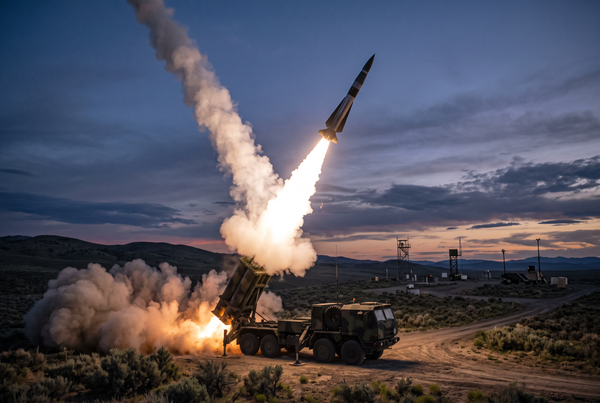
Ballistic missiles follow a largely predictable arc once they leave the pad. Hypersonic glide vehicles and some cruise missiles fly lower and can maneuver mid-flight, so a sensor that only catches the launch cannot reliably keep custody of the target the whole way. Full-flight tracking is the attempt to hold that custody from boost through impact.
The birds already on contract
SDA does not wait for a perfect design. It adds a new generation of Tracking Layer satellites roughly every two years, refreshing the architecture with targeted upgrades each cycle. The generation already bought is a mix of warning sensors and missile-defense payloads, and half of Tranche 3 is supposed to generate fire-control-quality tracks.
On December 19, 2025, the agency made four awards totaling approximately $3.5 billion to build 72 Tracking Layer satellites, with teams led by Lockheed Martin, Rocket Lab USA, Northrop Grumman, and L3Harris each delivering 18 space vehicles for launch in fiscal year 2029. Lockheed Martin is building 18 missile warning, tracking, and defense satellites for $1.1 billion. Rocket Lab USA is building 18 of the same class for $805 million. L3Harris is providing 18 missile warning and tracking satellites for $843 million, and Northrop Grumman is providing 18 missile warning and tracking satellites for $764 million. The layer is designed to track conventional and advanced missile threats, including hypersonic missile systems.
"The Tracking Layer of Tranche 3, once integrated with the PWSA Transport Layer, will significantly increase the coverage and accuracy needed to close kill chains against advanced adversary threats," SDA Acting Director Gurpartap "GP" Sandhoo said then.
The July follow-on compressed that timeline for homeland defense. On July 13, 2026, SDA issued two agreements totaling approximately $1.75 billion to field 36 Accelerated Missile Defense Tranche 3 satellites across four orbital planes, in support of Golden Dome for America's space-based capabilities. L3Harris Technologies of Fort Wayne, Indiana, is building 18 "HBTSS-like" missile defense variant satellites across two planes for approximately $955 million. Sierra Space Corporation of Louisville, Colorado, is building 18 missile warning and missile tracking variant satellites across two planes for approximately $798 million. Both are firm-fixed-price other transaction authority prototype agreements, and the satellites are expected to be available for launch by the end of 2028.
"With these awards, SDA is accelerating the deployment of the Tracking Layer to provide the homeland, our deployed forces, and allies with global, persistent indications, detection, identification warning, tracking, and defense against advanced and evolving missile threats," said Sandhoo, Space Force Portfolio Acquisition Executive for Missile Warning and Tracking and SDA Director.
What Tranche 4 is actually asking
Adding satellites on orbit does not by itself solve custody through a maneuver. After the feedback phase, SDA plans a Tranche 4 solicitation that includes both production contracts and partnership opportunities for rapid prototyping and flight demonstrations of new mission payloads. The sequence is deliberate: get industry to fly the harder tracking job, then decide what belongs in the production buy.
That hunt includes capabilities to detect and follow targets throughout their flight. The RFI is the mechanism for turning that requirement into something that can be demonstrated on orbit on a short fuse, rather than waiting for another two-year spiral to guess at the payload.
Golden Dome still needs the track
Golden Dome only works if the track handed to an interceptor is good enough to shoot. Launch detection tells the system that something is in the air. Fire-control-quality custody through the midcourse and terminal phases is what lets a defender engage a target that can change course after it is already flying. Tranche 3 and the accelerated 36-satellite buy put warning and defense payloads on a compressed calendar. The October notice is the agency asking how those payloads, or the next ones, keep a maneuvering target in the crosshairs for the whole ride.
The December 4 responses, and the on-orbit demonstrations they are meant to shape, will decide whether the Tracking Layer can hold a hypersonic missile from launch to impact, or only see it leave the pad.