Why the Army's $863 Million Artillery Bet Is on $15,000 Screw-In Fuzes, Not Excalibur
The Army locked a five-year, $862.8 million IDIQ for Northrop Grumman's M1156 Precision Guidance Kit, the $15,000 screw-in fuze that turns stock 155mm shells into GPS-corrected rounds. The next variants are built for jammed battlefields, and the line already belongs to one producer.
On September 3, 2026, the U.S. Department of War announced that Army Contracting Command in Newark, New Jersey, awarded Northrop Grumman Systems Corp. a firm-fixed-price, indefinite-delivery/indefinite-quantity contract to manufacture, inspect, test, package, and deliver M1156 Precision Guidance Kits and variants through September 3, 2031. The ceiling is $862,848,000. Work will run from Minneapolis and Plymouth, Minnesota. Bids were solicited over the internet, and one offer came back.
That single bid is the industrial fact underneath the tactical one. Northrop Grumman already owns the Army's standard way to put GPS on ordinary 155mm steel. Contract W15QKN-26-D-A072 keeps that line funded for five years.
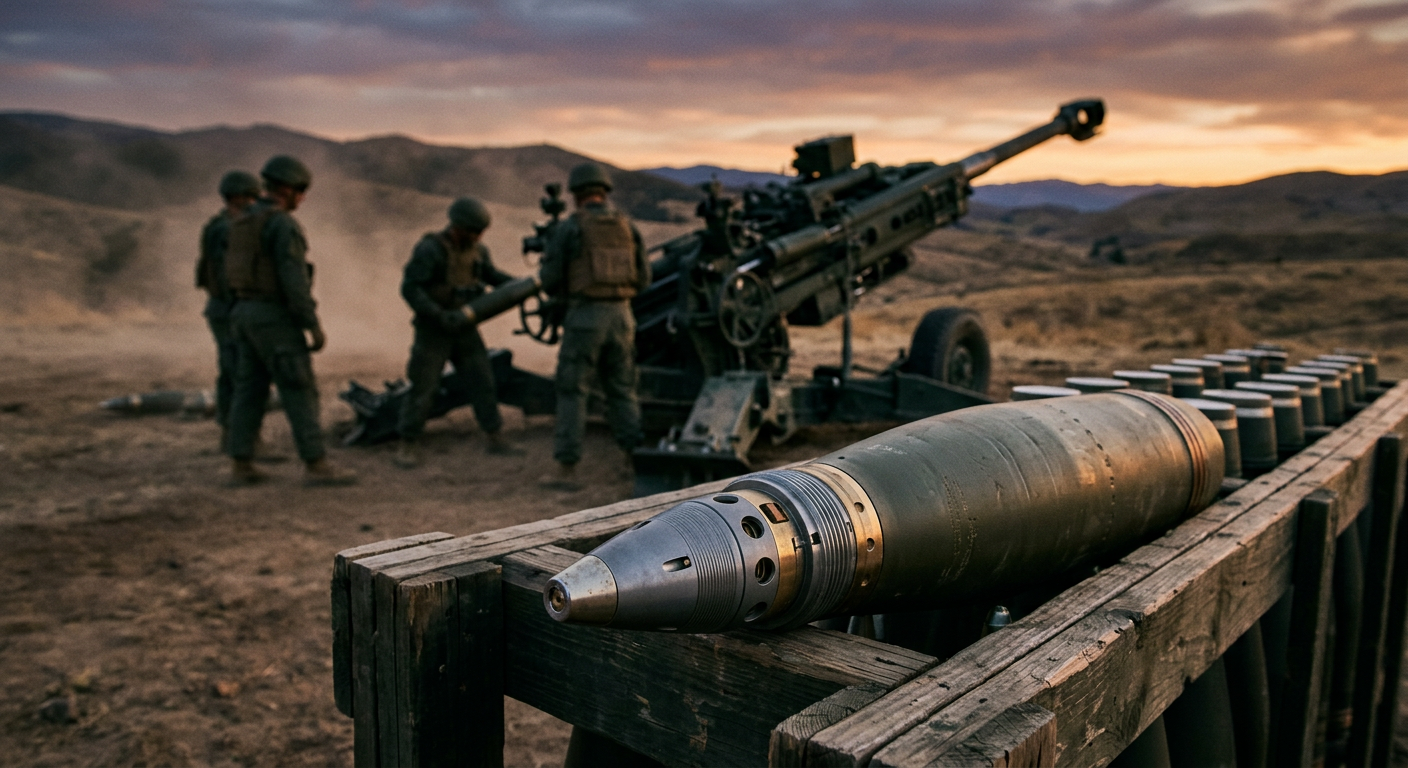
The kit does not replace the projectile. It screws into the standard NATO deep-intrusion fuze well of existing unguided high-explosive shells, including the M795 and M549A1 and the newer XM1113 and M1128, then flies from M109A6 and M109A7 Paladin howitzers and the M777A2 lightweight towed gun. Batteries keep their stockpile and add a guidance kit. That is the industrial logic of the award: buy more fuzes, not a new family of boutique shells.
The Economics of Precision Mass
Unguided 155mm fire still opens a wide pattern at long range, often 200 to 300 meters or more in circular error probable. The PGK packs a GPS receiver and small aerodynamic control fins into the fuze, then steers in flight. Threshold accuracy is a CEP under 50 meters. The objective is under 30 meters, enough to transform a dump of conventional shells into a precision magazine.
Raytheon's M982 Excalibur still owns the tightest shot, near a 4-meter CEP, at roughly $68,000 to more than $100,000 a round. The PGK costs about $15,000 a kit. Commanders who can put a conventional shell inside a 30-to-50-meter circle can destroy many point and area targets with far fewer rounds, which cuts the trucks, propellant, and heavy steel that artillery units otherwise haul. The Army just signed an $862.8 million deal that buys that cheaper path at scale rather than spending Excalibur money on every fire mission. Precision mass, in this accounting, is a fuze problem first.
Hardening Guidance Against Electronic Warfare
Ukraine made the next problem unavoidable. Heavy Russian electronic warfare has jammed GPS across wide stretches of the front, and a fuze that trusts an unprotected signal will fly like iron when the spectrum goes dark. The Army and Northrop Grumman have already moved the design. The M1156A1 configuration uses military M-code GPS, which reached full materiel release in 2025. The PGK E5 configuration adds advanced GPS anti-jam so the kit can still correct in a contested electromagnetic environment.
Those upgrades sit on a line that already exists. More than 145,000 PGK units have been delivered. In operational testing and combat deployments since 2013, the kit has demonstrated a 98 percent point reliability rate. Power is self-generating. Shelf life is 20 years. The Army is buying a fuze it already fields, then paying to keep that fuze alive under the jamming that now defines high-intensity artillery war. M-code and E5 are the price of keeping a 50-meter kit useful once GPS is no longer a free good.
Industrial Moat and Allied Export Pipelines
For Northrop Grumman (NYSE: NOC), the ceiling is modest against the rest of the book. The company carries a record $105 billion backlog after $20 billion in second-quarter 2026 net awards, against 2026 sales guidance of $43.75 billion to $44.25 billion. The $862.8 million IDIQ is about 0.8 percent of that backlog. What it locks is sole-source production of the Army's trajectory-correction kit through 2031, plus an export path to NATO allies and other partners.
That channel already has a physical pairing. Northrop Grumman works with Rheinmetall Denel Munition on the 76-kilometer V-LAP projectile, matching long-range South African ballistics with American guidance. Five years of U.S. framework orders give that pairing a demand signal that outlasts any single delivery order.
Excalibur remains the round when a 4-meter CEP is the requirement. Everyday precision, from 2026 through 2031, will come from a $15,000 screw-in fuze with M-code and anti-jam variants, a 98 percent reliability history, and a single qualified producer. Northrop Grumman already owns that line. The new IDIQ pays it to keep running.