The Navy Killed the Program Anduril Built a Shipyard For. Seven Other Companies Won the One That Replaced It.
Anduril spent tens of millions revamping a Seattle shipyard for a Navy autonomous-vessel program. The Navy canceled that program, and named Huntington Ingalls, Leidos, and five others to build the one that replaced it.
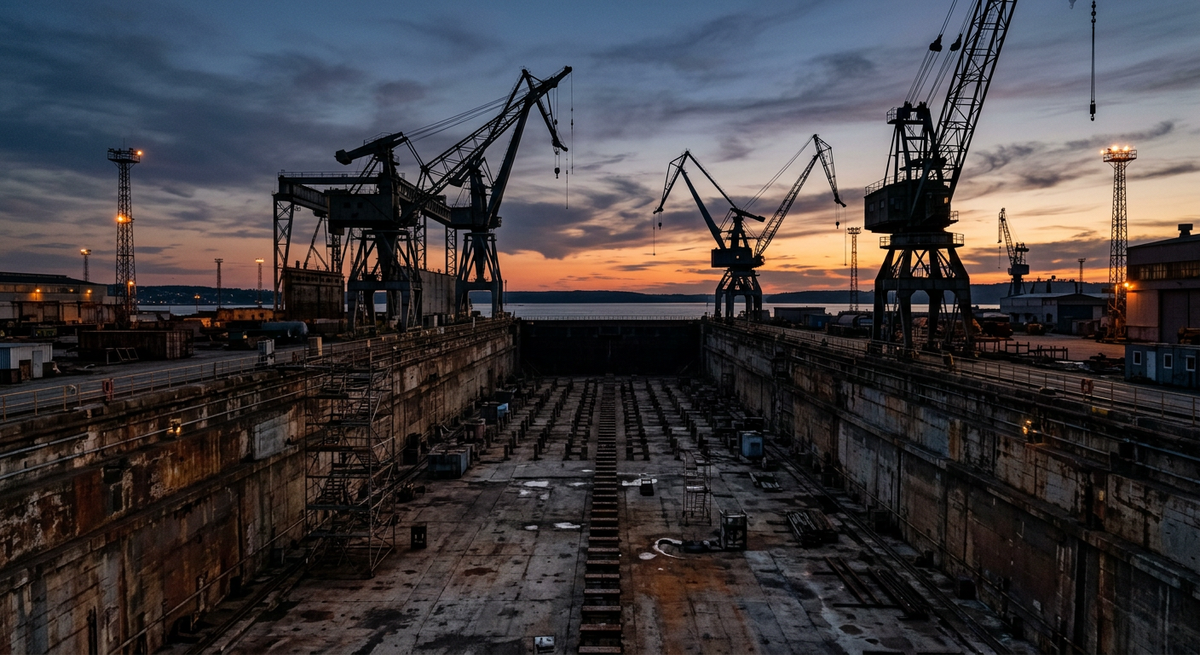
Anduril Industries spent late 2025 telling the world it was going to rebuild American shipbuilding from a retired Seattle shipyard. This month, the company quietly moved out. The U.S. Navy program Anduril built that facility for no longer exists, and when the Navy picked seven companies to build the autonomous ships that replaced it, Anduril was not one of them.
Tens of millions into a shipyard
The story starts in November 2025, when Anduril and South Korea's HD Hyundai Heavy Industries announced a partnership to design and build a new class of autonomous surface vessels. The centerpiece of the U.S. side of that plan was the historic former Foss Maritime shipyard on Seattle's Lake Washington Ship Canal, which Anduril said it had invested "tens of millions of dollars" to revamp as its hub for assembling and testing vessels built for the Navy's Modular Attack Surface Craft program, known as MASC. Anduril framed the site as proof that autonomous warship production could be rebuilt on American soil, evoking the Pacific Northwest's wartime shipbuilding legacy.
MASC itself was built around a specific kind of ship: an unmanned vessel that could carry two 40-foot shipping containers at 25 knots for up to 2,500 nautical miles, hauling large payloads alongside the Navy's manned surface fleet.
The program Anduril built for stopped existing
That program did not survive to see a competition. In March 2026, the Navy's Portfolio Acquisition Executive for Robotics and Autonomous Systems, Rebecca Gassler, told reporters the service was canceling MASC outright. Gassler said the program's specifications had been too narrowly tailored, and that the Navy wanted a more flexible, multi-mission unmanned vessel instead. In its place, the Navy stood up something it called a Medium Unmanned Surface Vessel marketplace: a recurring, open solicitation where companies bring mature, already-developed designs to at-sea testing rather than competing for a single locked-in program.
Two months later, on May 29, the Navy named the seven companies whose designs would move on to at-sea demonstrations: Sea Machines, Leidos, Saronic Technologies, Galliano Marine Services, PacMar Technologies, Birdon, and Huntington Ingalls Industries. Anduril was not on the list. Companies whose vessels pass the at-sea test receive $15 million each and become eligible for follow-on production; testing began in June and is due to wrap up by October.
Anduril confirmed to GeekWire this month that it has vacated the Foss shipyard space. "The space supported a Navy program pursuit; the Navy canceled that program, and the shipyard footprint was no longer needed," a company spokesperson said, adding that the shipyard presence had always been small, a handful of employees, and that Anduril's broader Seattle footprint continues to grow. The company did not answer questions about its plans, if any, for the new MUSV marketplace.
A small loss inside a much bigger bet
By Anduril's own account, the shipyard was never a large piece of its business, and nothing about this changes the trajectory the company has been on elsewhere. Anduril closed a $5 billion funding round in May that doubled its valuation to $61 billion, and it is reportedly seeking a new round at a $100 billion valuation. Its Seattle-area headcount has grown from roughly 30 employees four years ago to 560 today, and the company has said it could eventually employ 1,000 people in the region working on hardware and software unrelated to shipbuilding.
What the Foss exit does show is that even a company raising money at a pace few defense contractors can match is not immune to the Pentagon simply changing its mind about what it wants to buy. Anduril bet a shipyard on a specific acquisition program, the Navy scrapped that program for a different approach, and the field that replaced it ended up including three shipbuilders with far longer track records in the water: Huntington Ingalls, Leidos, and Saronic. Whether Anduril responds to the new MUSV marketplace with a design of its own, using the same HD Hyundai partnership or something built entirely in the U.S., is a question the company has not yet answered publicly.