GM Defense Scaled Commercial Pickup Architecture Into a 12,000-Vehicle Army Standard
The U.S. Army expanded its Infantry Squad Vehicle requirement by 1,750% to nearly 12,000 units, scaling GM Defense's commercial-chassis platform across 39 brigades.
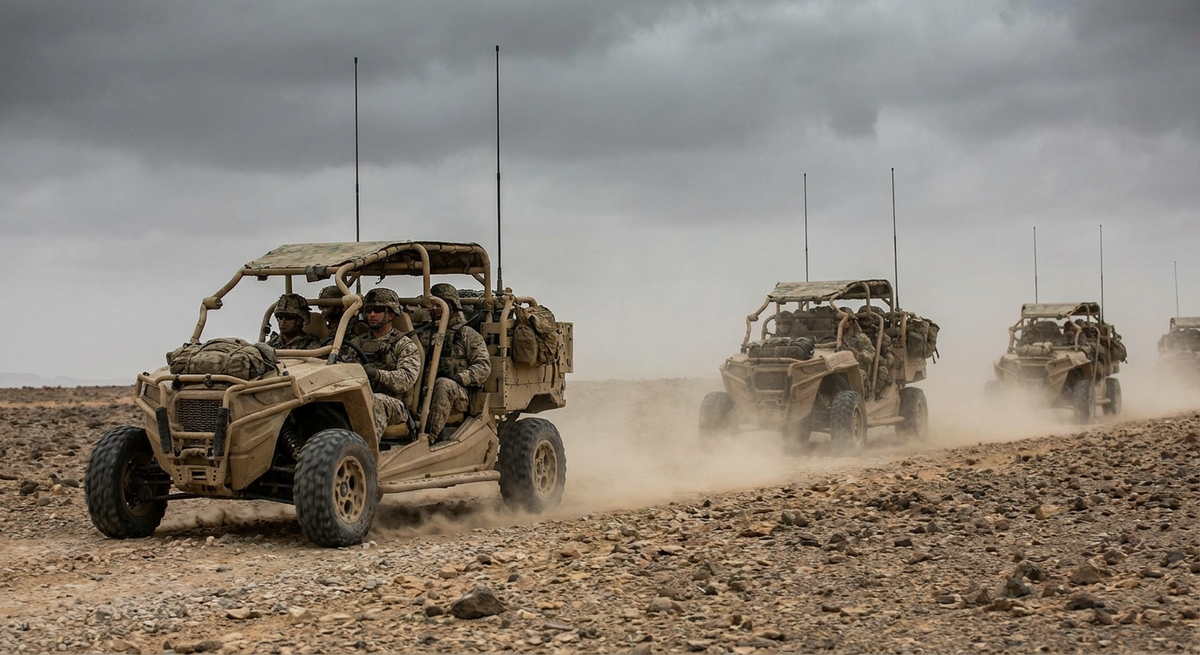
The U.S. Army is treating a Chevrolet-derived light truck as a brigade mobility layer, not a niche scout. On October 12, 2026, at the Association of the United States Army Annual Meeting in Washington, D.C., GM Defense announced that the planned Infantry Squad Vehicle procurement has grown from an original program of record of 649 vehicles to nearly 12,000 units. That is an increase of roughly 1,750 percent over the baseline buy.
The priced paperwork arrived three weeks earlier. On September 21, 2026, U.S. Army Contracting Command-Detroit Arsenal awarded GM Defense LLC, a subsidiary of General Motors (NYSE: GM), a $697,686,693 modification (P00053) to existing contract W56HZV-20-D-0066. The change covers engineering change proposals for the Infantry Squad Vehicle Utility and an associated winch kit. It lifts the program's cumulative face value from about $214.3 million to $915,597,166, with work scheduled through June 25, 2028.
The modification pays for a utility variant and kit. The AUSA number describes a fleet the Army now wants at Mobile Brigade Combat Team scale.
A 39-brigade buy built around an unarmored hull
The expanded ISV inventory is to be fielded across 39 active-duty and National Guard mobile brigades supporting newly formed Mobile Brigade Combat Teams. In standard configuration the vehicle is unarmored, without doors or windows, so it can be sling-loaded by a UH-60 Black Hawk and fit inside a CH-47 Chinook. Air-transportability and cross-country speed are the design priorities. Crew protection is not.
That trade is explicit, and it is incorporating lessons from Ukraine on dispersed, agile ground mobility. The ISV-Utility variant carries five soldiers plus modular payloads for command and control, electronic warfare, fire support, and counter-drone systems.
GM Defense did not wait for a formal Army requirements cycle to offer the utility and logistics role. The company identified the operational gap, self-funded development of the ISV-Utility prototype, and handed over seven prototypes at no cost for unit-level operational evaluations. The Army is now wrapping a nearly 12,000-vehicle requirement around a family that began as a commercial pickup and a company-funded kit.
Commercial truck lines as the industrial case
The ISV and ISV-Heavy are built on the Chevrolet Colorado ZR2 and the Chevrolet Silverado HD 3500 ZR2, with about 90 percent commercial off-the-shelf components and access to GM's global supply chain. That mix is why a 1,750 percent jump from 649 vehicles is even plausible on paper. The Army is buying into an existing truck architecture rather than standing up a purpose-built combat-vehicle line.
GM Defense used AUSA to show how fast that base can move on a defense part. It produced and delivered mission-critical PAC-3 Missile Segment Enhancement housing components to Lockheed Martin in 22 days, with the contract signed August 6 and hardware in hand August 28. The company also displayed an autonomous unmanned ground vehicle on a Silverado 3500HD dual-rear-wheel skateboard chassis for casualty evacuation and logistics, with field trials planned for 2027, and the EPIQ Hybrid 60-kilowatt / 100-kilowatt-hour tactical energy storage system.
Twelve thousand vehicles, and a smaller check
A $697,686,693 engineering-change modification that takes the contract face value to $915,597,166 is large for a light vehicle line. It is still small relative to a nearly 12,000-unit fleet. The near-term dollars buy ISV-Utility change proposals and a winch kit through June 25, 2028. The AUSA figure is the Army describing where it wants the program to go across 39 brigades.
The bet is that commercial pickup architecture, 90 percent off-the-shelf content, and an unarmored air-mobile hull can serve as the mobility layer for Mobile Brigade Combat Teams without a traditional combat-vehicle cost curve. GM Defense already put seven no-cost prototypes into units to make that case. The Army has now put a 1,750 percent requirement increase on it. Whether the commercial line can absorb defense-specific engineering changes at that volume, without losing the 22-day PAC-3 housing turnaround, is the question the next contract actions will have to answer.