Boeing Defense Grew 13%—Then Gave It Back on Air Force One
Boeing’s BDS unit posted $7.483B revenue (+13%) but a $15M operating loss after $280M in VC-25B charges. MQ-25A hit first flight and Milestone C; T-7A entered LRIP; backlog ~$85B with 27% non-U.S.
Boeing’s Defense, Space & Security unit finally posted the kind of top-line acceleration defense investors had been waiting for—then handed most of the operating punch back on a single presidential aircraft program. In its second-quarter 2026 results, Boeing reported BDS revenue of $7.483 billion, up 13% from $6.617 billion a year earlier, alongside an operating loss of $15 million. Embedded in that near-breakeven print: $280 million of VC-25B charges.
The arithmetic is the story. Volume returned. Margin did not. For a franchise still rebuilding credibility after years of fixed-price pain, Air Force One remains the bill that shows up just as the rest of the portfolio starts to look healthier. That tension—growth versus program-specific charges—is now the central lens for reading Boeing Defense.
Growth that did not translate
Boeing said Defense, Space & Security’s second-quarter revenue was “driven by higher volume,” with operating margin of (0.2)%. Year-ago operating earnings were $110 million, so the swing to a $15 million loss is not a rounding error—it is the VC-25B overlay on otherwise stronger activity.
The company was unusually direct about the charge. Results include $280 million of losses on the VC-25B program “primarily driven by an investment in additional production and certification resources,” according to the July 28 release. Boeing continues to anticipate first delivery in 2028. That date is an expectation, not a contractual guarantee in the earnings text, and investors should treat it as management guidance rather than a hard delivery commitment.
Company-wide, Boeing recorded $24.6 billion in revenue, GAAP loss per share of ($0.67), and core loss per share of ($0.76). Operating cash flow was $1.4 billion. Those totals are dominated by commercial recovery—171 deliveries in the quarter—but they set the cash backdrop against which BDS’s thin margin sits. Free cash flow of $0.6 billion, after elevated capital spending, underscores that Boeing is generating cash again even as defense profitability remains fragile.
Program bright spots beneath the charge
Strip out VC-25B and the quarter still contained operational markers that matter for the defense backlog. Boeing said Defense, Space & Security secured a U.S. Space Force award for proprietary communications capabilities, successfully completed first flight and received Milestone C on the U.S. Navy MQ-25A Stingray, and began low-rate initial production of the U.S. Air Force T-7A Red Hawk.
Those are different kinds of milestones. Milestone C and first flight on MQ-25A move an unmanned carrier-based tanker toward production decision maturity—an important Navy aviation modernization thread. T-7A LRIP is the classic early manufacturing ramp for a trainer that has been long in development. Neither offsets a $280 million presidential-aircraft charge in the current quarter, but both feed the medium-term narrative that BDS is not solely a VC-25B story.
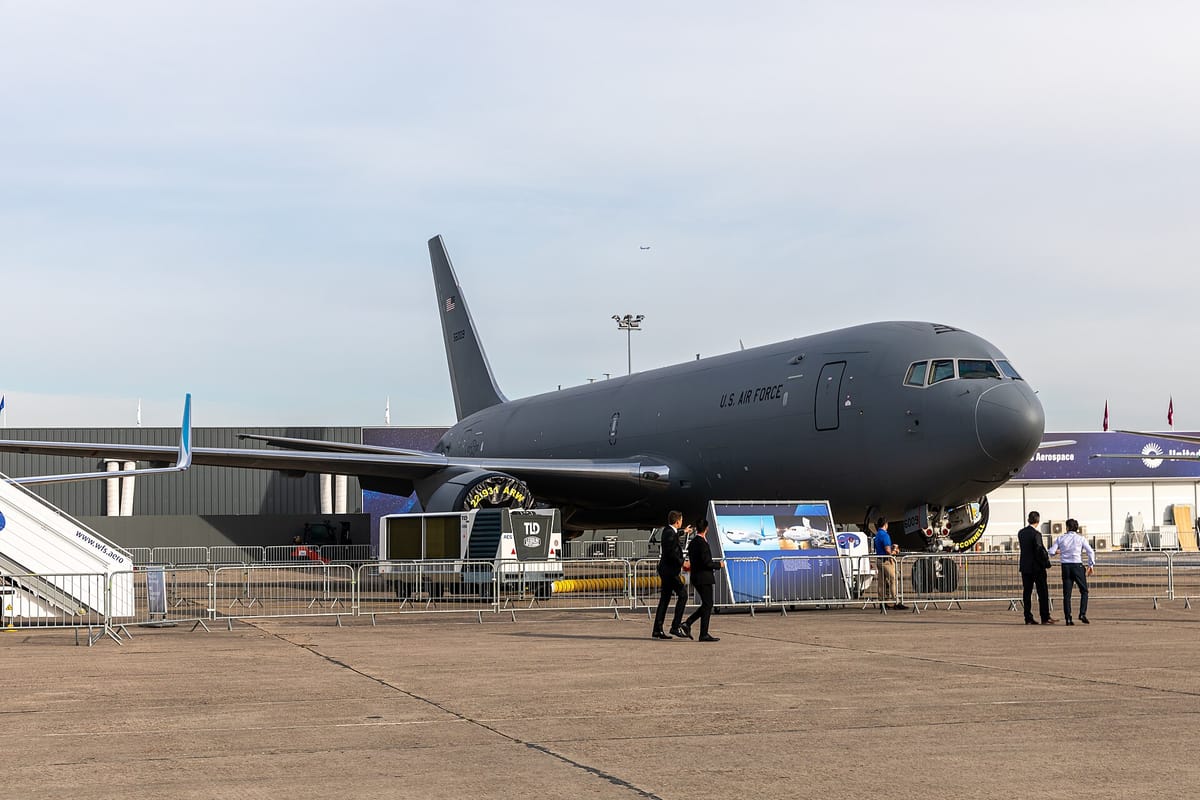
Backlog at Defense, Space & Security was about $85 billion, with 27% representing orders from customers outside the United States, Boeing reported. In the detailed backlog table, BDS stood at $85.322 billion as of June 30, 2026. International mix at more than a quarter of the book is a reminder that export tankers, fighters, and services remain a structural part of the segment’s value—especially as U.S. budget timing turns choppy under continuing resolutions. KC-46 deliveries in the quarter (four units in Q2, eight in the first half, per Boeing’s delivery table) keep the tanker franchise visible even as VC-25B dominates the earnings conversation.
How to read VC-25B without overtrading the headline
Fixed-price development programs have punished Boeing Defense before. The VC-25B charge fits that pattern: incremental investment in production and certification resources, booked as losses, with first delivery still guided to 2028. The investor question is whether $280 million is a late-cycle cleanup or another waypoint on a longer cost curve. The July 28 release does not answer that. It only discloses the quarter’s charge and the continued 2028 delivery expectation.
That asymmetry should keep models humble. Bulls can fairly point to 13% revenue growth, MQ-25A Milestone C, T-7A LRIP, and an $85 billion backlog with meaningful non-U.S. content. Bears can fairly point to a segment that grew into a loss because one program absorbed the operating leverage. Both readings are sourced. Neither requires inventing a new delivery date or assuming the charge is the last.
Comparisons to prior VC-25B charges in earlier periods are tempting but only useful when tied to prior primary filings. This article sticks to the Q2 2026 disclosure: $280 million in the quarter, first delivery anticipated in 2028, and a segment operating loss of $15 million despite higher volume.
Portfolio implication
For Boeing equity, BDS is still the stabilizing leg while Commercial Airplanes works through certification and rate. A 13% defense revenue print helps that thesis. A $15 million operating loss after $280 million of VC-25B charges complicates it. Until VC-25B stops writing eight-figure letters into the P&L, defense growth will keep arriving with an asterisk—visible in the primary filing, and ignored only at the reader’s peril.
The practical research checklist from July 28 is therefore short. Track whether subsequent quarters repeat VC-25B charges. Track whether MQ-25A and T-7A convert milestones into sustained production revenue. Track whether the 27% non-U.S. backlog mix translates into export awards that diversify Pentagon timing risk. Everything else is commentary. The numbers, for once, are plain.
Delivery tables in the same release also show the defense portfolio’s physical cadence: four KC-46 tankers and a mix of rotorcraft and fighters in the quarter, alongside the program milestones already noted. Those unit counts do not reverse a $280 million charge, but they confirm that BDS revenue growth is grounded in hardware movement—not only in accounting timing. For investors comparing Boeing to peers without a VC-25B overhang, that distinction matters: volume is present; it is simply not yet flowing cleanly to segment profit.
Finally, treat the 2028 first-delivery expectation as a living estimate. Boeing’s cautionary language elsewhere in the release reminds readers that forward-looking statements can change with certification, production, and customer decisions. Until a subsequent primary filing revises or reaffirms that date with new cost detail, the July 28 package remains the authoritative snapshot: 13% BDS growth, a $15 million operating loss, $280 million of VC-25B charges, MQ-25A first flight and Milestone C, T-7A LRIP, and an approximately $85 billion defense backlog with 27% non-U.S. content.