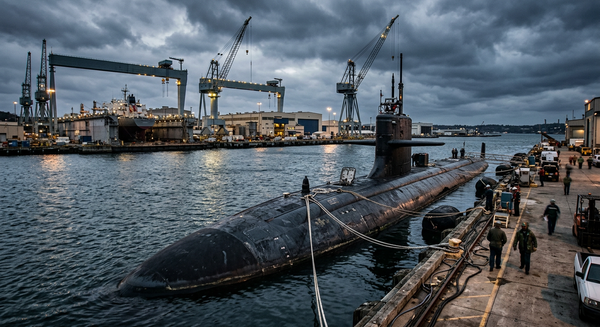
GD’s Marine Systems Growth and 1.4x Book-to-Bill Underscore the Submarine Supercycle
General Dynamics posted $14.1B revenue (+8.1%) and $4.24 EPS, with Marine Systems at $4.660B (+10.4%), Aerospace at $3.525B (+15.1%), and a 1.4x book-to-bill on $14.7B of defense orders.
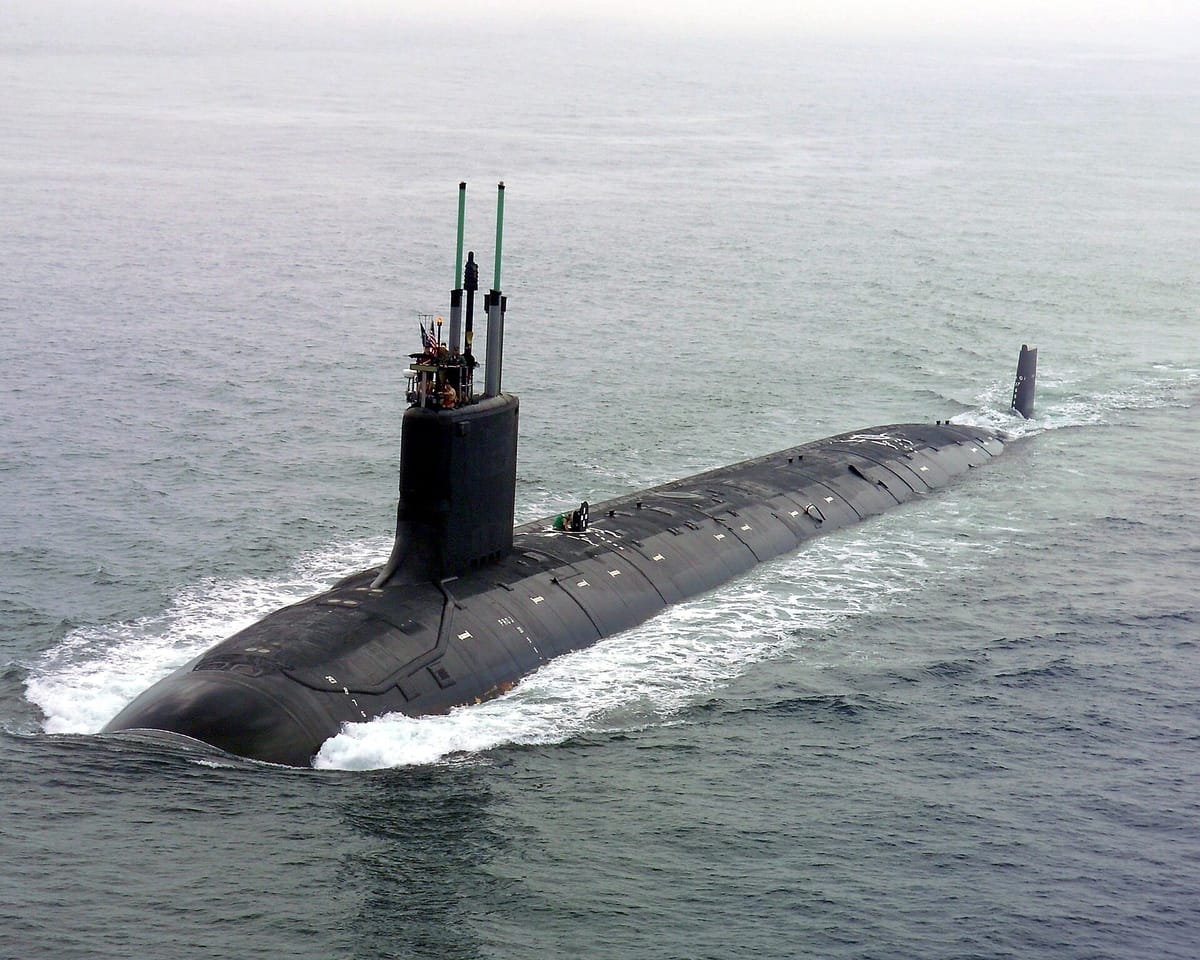
General Dynamics used the second quarter to remind the market what a submarine-heavy industrial cycle looks like when orders and execution move together. On July 29, 2026, the company reported revenue of $14.1 billion, up 8.1% year over year, and diluted EPS of $4.24. Marine Systems—home to the submarine and surface yards—delivered $4.660 billion in revenue, up 10.4%, while company-wide book-to-bill ran 1.4x.
In a defense market debating continuing resolutions and munitions anomalies, GD’s print was a different kind of signal: funded demand showing up as orders, and shipyard throughput showing up as double-digit marine growth. That combination is rarer than bullish rhetoric about a “supercycle,” and it is entirely visible in the company’s primary releases.
The scoreboard
Operating earnings were $1.5 billion, up 11.9%, with operating margin of 10.4%, a 40-basis-point expansion from the year-ago quarter, according to GD’s release and the parallel PR Newswire distribution. Cash from operating activities totaled $1.9 billion, or 162% of net earnings. During the quarter the company paid $429 million in dividends, invested $234 million in capital expenditures, and reduced total debt by $498 million, ending with $7.5 billion in total debt and $4.3 billion in cash.
Segment detail, from the PR Newswire exhibits, sharpens the mix. Aerospace revenue was $3.525 billion, up 15.1%, with operating earnings of $510 million. Marine Systems revenue of $4.660 billion compared with $4.220 billion a year earlier (+10.4%), and marine operating earnings rose 17.5% to $342 million. Combat Systems revenue was essentially flat at $2.290 billion; Technologies grew 4.1% to $3.619 billion. Chairman and CEO Phebe Novakovic pointed to “double-digit increases in revenue and noteworthy margin expansion in Aerospace and Marine Systems” and said GD is “continuing to make significant investments to increase output to meet strong and growing demand.”
Book-to-bill is the strategic headline
Orders received in the quarter totaled $14.7 billion in the defense segments and $5.3 billion in Aerospace, for $20 billion overall. Book-to-bill was 1.4-to-1 for defense segments, 1.5-to-1 for Aerospace, and 1.4-to-1 company-wide, GD said.
A 1.4x defense book-to-bill is not a one-quarter curiosity when Marine backlog already dominates the company’s funded outlook. At quarter end, total backlog was $136.5 billion. Estimated potential contract value was $50.4 billion, bringing total estimated contract value to $186.9 billion. The backlog exhibit shows Marine Systems alone at $65.182 billion in total backlog—nearly half the company’s book—plus another $7.442 billion of estimated potential contract value. That is the quantitative expression of the submarine supercycle thesis: Columbia- and Virginia-class work, and related yard loading, sitting as multi-year revenue visibility rather than as a slogan.
Defense orders of $14.7 billion against company revenue of $14.1 billion also matter for how investors should read CR risk. Stopgap funding can delay new starts elsewhere in the sector; GD’s second-quarter order intake suggests that, for this franchise, previously appropriated and under-contract shipbuilding demand was still converting into backlog even as Washington argued about anomalies.
Marine growth without promising the impossible
Ten-percent-plus marine revenue growth is the operating proof point. It does not, by itself, resolve known industrial-base constraints—supplier throughput, labor, and nuclear enterprise capacity—that GD and the Navy discuss in other forums. The earnings release does not quantify those constraints. What it does show is that, in Q2 2026, Marine Systems grew revenue and expanded margin (7.3% versus 6.9% a year earlier) while management publicly committed to output investment.
Aerospace’s 15.1% jump and 1.5x book-to-bill add a commercial-aviation counterweight that defense-only peers lack. Gulfstream deliveries in the quarter totaled 41 aircraft (35 large-cabin, 6 mid-cabin), per the supplemental aerospace data. Business-jet demand is a different cycle, but it dilutes pure Pentagon appropriation beta inside the GD multiple—an underappreciated feature when Washington is writing CRs instead of full-year bills.
How investors should use the print
The durable read is threefold. First, GD is growing through the marine franchise that defines its strategic premium. Second, 1.4x defense book-to-bill and $14.7 billion of defense orders argue that demand is still outrunning quarterly revenue. Third, nothing in the release invents a new Columbia or Virginia delivery schedule; the investable claim is growth and backlog quality, not a revised ship-by-ship calendar.
For allocation, that keeps GD in the “execution and funded backlog” bucket rather than the “hope for CR anomalies” bucket. In a summer when Senate appropriators are blocking multiyear munitions starts, a shipbuilder printing double-digit marine growth and 1.4x book-to-bill is offering a cleaner primary story—and one that still fits inside a single pair of company releases. Track the next quarter’s marine margin and book-to-bill for confirmation; treat July 29 as evidence, not as a perpetual forecast.
Cash conversion deserves equal weight beside book-to-bill. Operating cash flow at 162% of net earnings, paired with debt reduction and ongoing capital expenditure, is how a submarine supercycle shows up in the balance sheet: not as a single contract announcement, but as cash generation that funds yard investment while returning capital. Free cash flow of $1.646 billion in the quarter, after $234 million of capex, reinforces that Marine and Aerospace growth is translating into liquidity rather than only into unbilled receivables.
None of this immunizes GD from appropriation timing or supplier bottlenecks. It does, however, give investors a clean, primary-sourced Q2 template: $14.1 billion of revenue, $4.24 of diluted EPS, Marine at $4.660 billion (+10.4%), Aerospace at $3.525 billion (+15.1%), defense orders of $14.7 billion, and 1.4x book-to-bill against a $136.5 billion backlog dominated by Marine Systems. That is the supercycle expressed in numbers—and it requires no invented delivery dates to be investable.