Super Hornets Will Keep Flying as Tankers Until Stingray Reaches the Fleet
The Navy has put Boeing's MQ-25A Stingray into low-rate production, a $562 million Lot 1 start that leaves Super Hornets doing tanker duty until 2029 to extend the carrier air wing's strike radius.
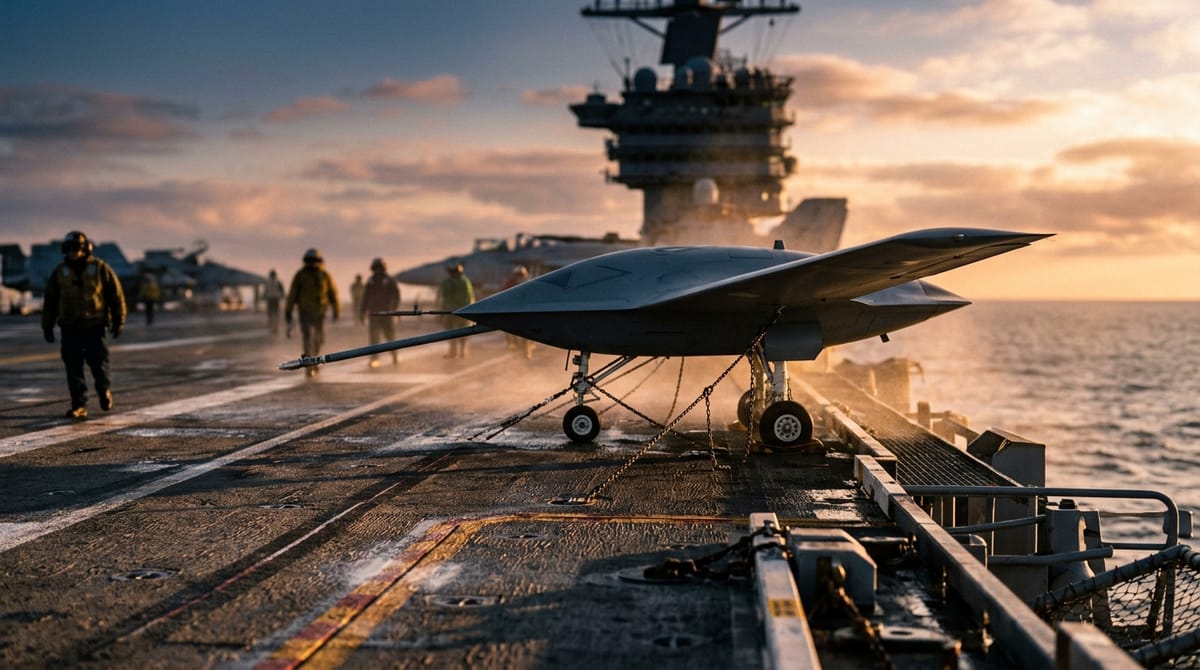
On September 14, 2026, the U.S. Navy awarded Boeing a $562 million fixed-price incentive contract for Lot 1 low-rate initial production of the MQ-25A Stingray, the first carrier-based unmanned tanker to enter production. The contract funds three Lot 1 aircraft and advanced procurement of long-lead parts for three Lot 2 airframes, with first Lot 1 deliveries planned for 2029. Against a 76-aircraft program of record, three jets are a manufacturing start. The hole they are meant to fill is larger.
Carrier air wings have spent years trading combat sorties for fuel. Super Hornets fly as tankers so other Super Hornets and F-35Cs can reach targets. That arrangement burns expensive fighter structure and still leaves the air wing short of Western Pacific ranges. MQ-25 is supposed to reverse both problems: offload at least 14,000 pounds of fuel 500 nautical miles from the ship, stretch strike radius toward 800 to 1,000 nautical miles, and put manned fighters back on combat missions. Production has now started. The air wing will not feel it until the decade's end.
The buddy-tanking tax on Super Hornets
The F/A-18E/F Super Hornet's combat radius is about 500 nautical miles. The F-35C reaches about 600. Those numbers assume a useful weapons load and a realistic recovery window. To stretch them, the Navy has used buddy tanking: Super Hornets fitted with Cobham external fuel pods that give gas to other strike fighters. Between 20 percent and 30 percent of Super Hornet sorties are consumed that way. Every one of those sorties is a combat aircraft not carrying weapons. Super Hornets also have a finite structural budget. Using them as flying gas stations ages the fleet on missions that do not put ordnance on a target. If Stingray can hold a tanker station at range, Super Hornets stop subsidizing the strike package with their own hours.
Indo-Pacific geometry still outruns the air wing
The range math is worse in the Western Pacific than it looks on a chart. Chinese DF-21D and DF-26 anti-ship ballistic missiles are credited with reaches from about 1,000 miles to more than 2,500 miles. A carrier that closes to give Super Hornets a 500-nautical-mile shot puts the ship inside that envelope. Standing off hundreds of miles from a hostile coastline is the prudent answer, and it leaves manned fighters short of the target without a tanker.
Land-based Air Force tankers, the KC-46 and KC-135, cannot safely orbit in that contested airspace. They are large, unarmed, and built for permissive refueling tracks. The Navy has to bring the tanker with the carrier. That is Stingray's job: organic, unmanned aerial refueling that travels with the air wing. Fourteen thousand pounds of fuel at 500 nautical miles is the threshold the program has advertised. If the jet meets it, F/A-18s and F-35Cs can fight from 800 to 1,000 nautical miles, a different campaign geometry than today's buddy-tanked air wing.
What Lot 1 buys, and what it still costs
Lot 1 is not a fleet. Three production aircraft, plus long-lead money for three more, are a start, not an operational inventory. The program of record still calls for 76 air vehicles: 67 operational jets and nine developmental and test aircraft. Initial Lot 1 deliveries in 2029 line up with a slipped initial operational capability, not with the original 2025 baseline.
The Pentagon's April 2026 Modernized Selected Acquisition Report put IOC in 2029, four years late, after technical risk, flight-test slips, and labor strikes. That estimate priced total acquisition at $19.4 billion, or $255.8 million per aircraft when research, development, test, and evaluation and military construction are included. A Congressional Research Service report (IF12972, updated August 2026), citing the GAO Weapon Systems Assessment, lists $16.6 billion excluding military construction, or $218 million per unit. Either figure is the price of stopping Super Hornets from flying as tankers. Neither buys a 2026 combat capability.
A factory in Illinois, a control system at sea
Boeing is building the aircraft at a dedicated $200 million plant at MidAmerica St. Louis Airport in Mascoutah, Illinois, with Rolls-Royce AE 3007N turbofan engines. Lockheed Martin supplies the Multi Domain Control Capability software for the Unmanned Carrier Aviation Mission Control System (UMCS / MD-5). The air vehicle is only half the system. The other half is a carrier that can control it. In March 2026, USS Theodore Roosevelt (CVN 71) became the first operational aircraft carrier fitted with an Unmanned Air Warfare Center supporting MQ-25A, a deck and command path the rest of the force will have to copy.
The industrial pieces are now in motion: a production contract, a dedicated factory, an engine, a control stack, and one carrier already wired for unmanned tanking. The operational payoff is still a 2029 event. Until Lot 1 jets are holding a 500-nautical-mile tanker station, Super Hornets will keep burning structural life so the rest of the air wing can reach.