The Pentagon Is Bringing Counter-Drone Lasers and Microwaves to Domestic Bases
JIATF-401 selected four directed-energy systems for a homeland C-UAS pilot. Lasers and microwaves now head to U.S. bases, with FAA airspace rules and a December Dugway shoot-off still ahead.
The Pentagon spent years treating high-energy lasers and high-powered microwaves as experimental weapons for overseas combat. On October 5, 2026, the Department of War announced a different destination. Joint Interagency Task Force 401 selected four industry directed-energy systems for a counter-unmanned aircraft systems pilot on U.S. military installations.
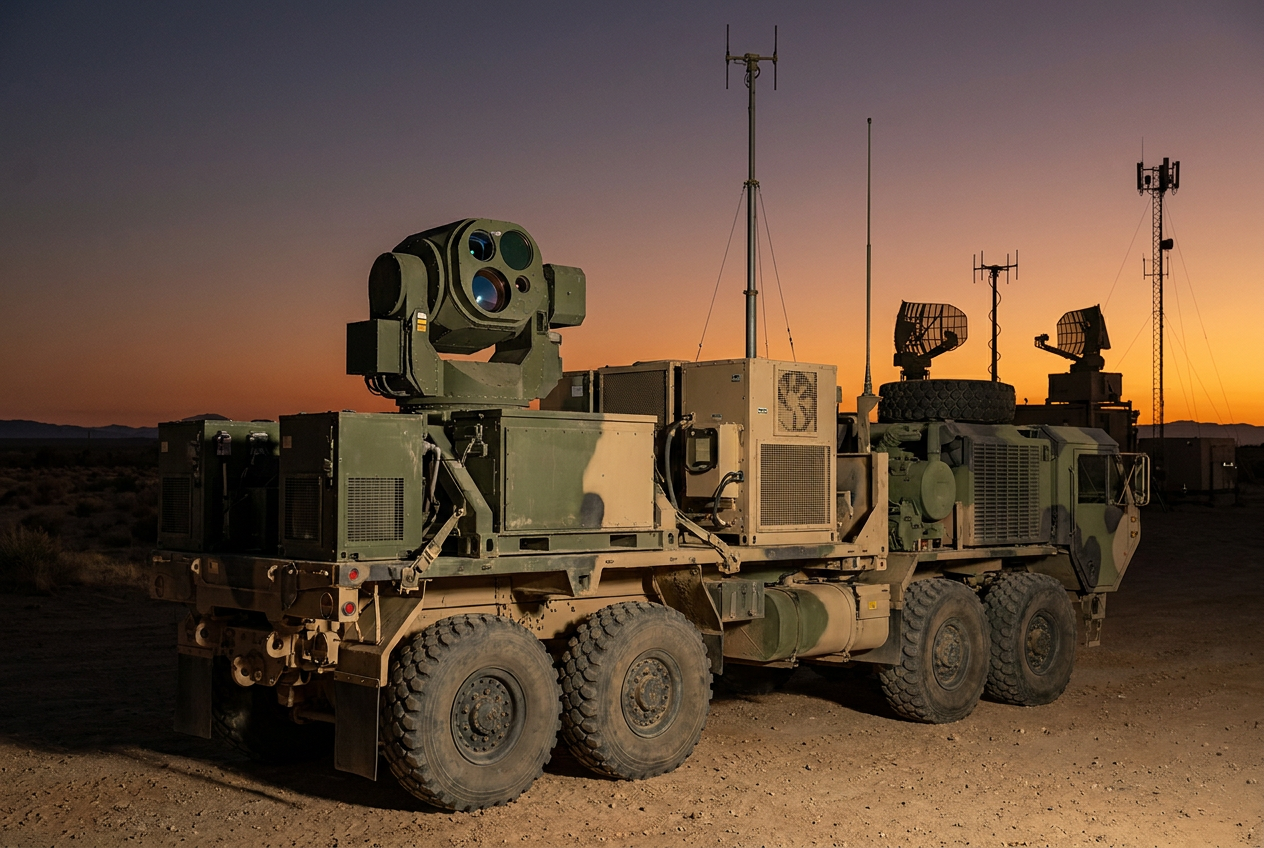
Congress mandated the program in the Fiscal Year 2026 National Defense Authorization Act to evaluate operational requirements, costs, and integration of directed energy in the homeland. The four systems are AeroVironment's palletized high-energy laser from the LOCUST family, a roll-on/roll-off unit; the Epirus Leonidas high-powered microwave; Kord Technologies' Firefly high-energy laser, a KBR subsidiary product scalable from 5 to 40 kilowatts; and Boeing's Compact Laser Weapon System, a 5-kilowatt class laser. In May 2026, JIATF-401 designated five initial host installations: Fort Huachuca in Arizona, Fort Bliss in Texas, Naval Base Kitsap in Washington, Grand Forks Air Force Base in North Dakota, and Whiteman Air Force Base in Missouri.
U.S. Army Brig. Gen. Matt Ross, director of JIATF-401, stated, "High-energy lasers and high-powered microwave systems are tools that can be effectively used in a layered drone defense. This pilot program will test these capabilities in an operational environment so we can understand how best to integrate and sustain them to defend the homeland." He also noted there is no silver bullet, or one size fits all solution to countering the threat of drones. Directed energy gives commanders another option within a layered defense. Ross also cautioned against overly simplistic "8 cents a shot" claims, noting that if a $6 million system is procured and fires once a year, the actual lifecycle economics look very different.
Lasers punch holes. Microwaves hit the swarm.
The four selections split along a tactical line. High-energy lasers from AeroVironment, Boeing, and Kord deliver concentrated thermal energy to burn through individual drone structures and optics. High-powered microwave from Epirus emits a broad electromagnetic pulse that disrupts or fries the internal electronic circuits of entire swarms at once.
AeroVironment secured a $464.8 million Army contract in September for the 30-kilowatt LOCUST X3 under the Enduring-HEL program. Boeing's Compact Laser Weapon System previously proved capable against Group 3 drones at Red Sands in Saudi Arabia. Kord's Firefly demonstrated multi-kilowatt mobile capability in Alabama and is the only selected laser described as scalable from 5 to 40 kilowatts. A 5-kilowatt class system and a 30-kilowatt palletized unit impose different power, cooling, and crew demands on a stateside installation.
Leonidas is the swarm answer. In September 2025 testing at Camp Atterbury, Indiana, the Epirus system neutralized 61 drones across five runs, including a 49-drone swarm in a single pulse. That is the case for area defense: one shot, many airframes, if the electronics are exposed and the pulse can be fired without collateral effects on friendly radios or civilian gear.
El Paso showed why the FAA sits in the room
The pilot requires close coordination among JIATF-401, the Federal Aviation Administration, U.S. Northern Command, and the military services. In February 2026, the FAA temporarily closed airspace around El Paso International Airport in Texas because of an uncoordinated counter-drone laser operated by Customs and Border Protection, a system on loan from the Army near Fort Bliss. Fort Bliss is also one of the five host sites named in May.
After safety risk assessments and a live-fire demonstration at White Sands Missile Range in New Mexico, the FAA determined in April 2026 that high-energy laser systems with proper controls posed minimal risk to the National Airspace System. That finding depends on who owns the trigger, how the beam is geo-fenced, and how NORTHCOM, the services, and the FAA talk when a track appears over a base under commercial corridors. A laser is a narrow beam. An HPM pulse is an area effect. The pilot still has to show that Leonidas can be employed at a stateside base without coupling into aircraft avionics, airport radars, or garrison radios.
Dugway is where a pilot becomes a purchase order
In December 2026, the Pentagon and JIATF-401 will host a live-fire shoot-off at Dugway Proving Ground in Utah. Systems that demonstrate strong operational performance can immediately receive purchase orders to scale production lines.
The NDAA told the department to evaluate operational requirements, costs, and integration in the homeland. A laser that burns a Group 3 target in Utah still has to be sited at Kitsap, Grand Forks, or Whiteman without repeating El Paso. A microwave that can take 49 drones in one pulse still has to survive Ross's cost test: procurement price, shot rate, and the bill to keep the system alive in the year it barely fires. Layered defense, in Ross's framing, means directed energy sits beside other tools rather than replacing them. Dugway will decide which of the four systems get that chance.