How Northrop Grumman Solved the F-16's Radar-Jamming Blind Spot
The Air Force just put Northrop Grumman's internal IVEWS jammer into low-rate production. The suite lets F-16 Wild Weasels hunt enemy radars without hanging a pod or blinding their own AESA.
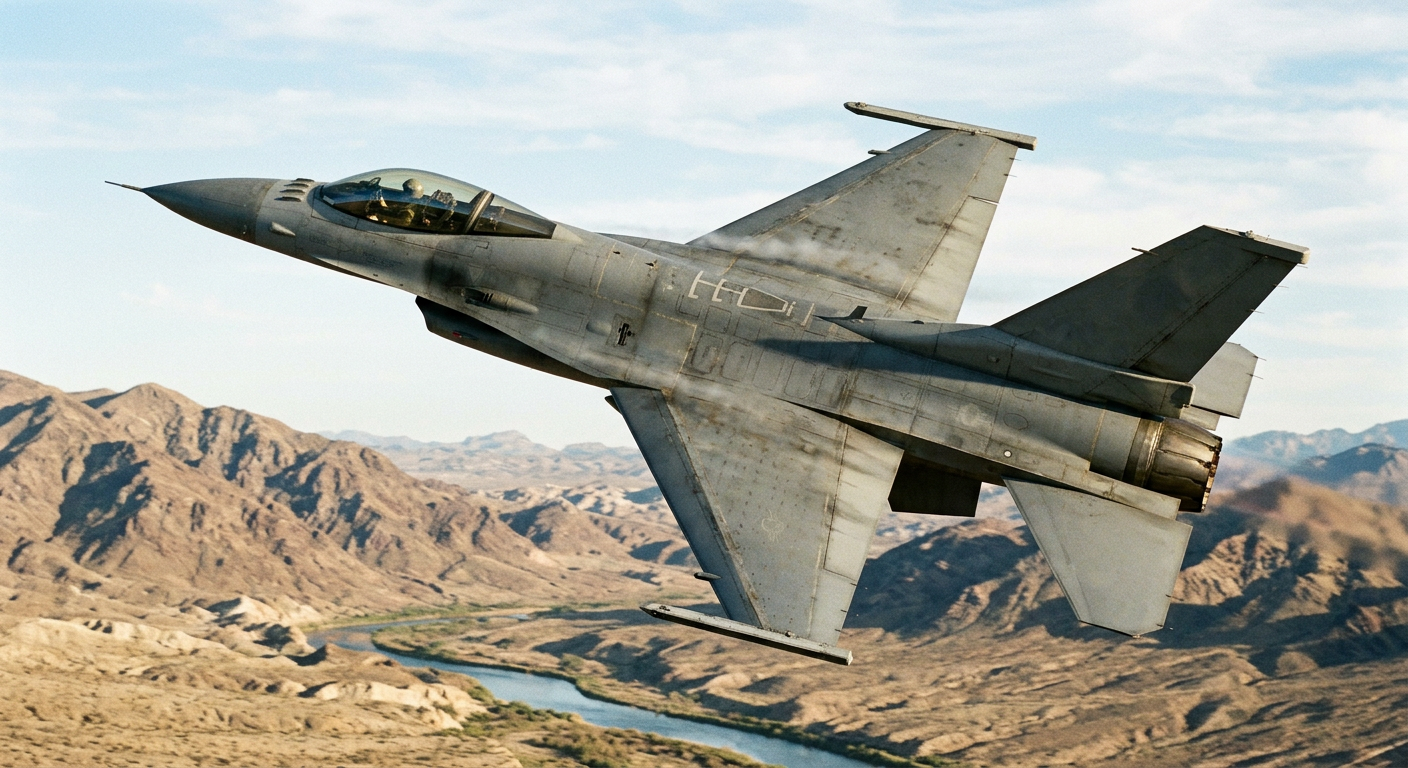
The F-16 has hunted radars for decades with a jammer hanging off the belly. On Sept. 24, 2026, the U.S. Air Force moved that work inside the jet. The service awarded Northrop Grumman Systems Corp. an $87,417,804 contract modification (P00188 to FA8615-17-C-6047) for Low-Rate Initial Production of the AN/ALQ-257 Integrated Viper Electronic Warfare Suite Electronic Warfare Radio Frequency Compatibility Program.
From an urgent need to low-rate production
The modification raises the cumulative face value of the IVEWS contract to $1,921,299,231, up from $1,833,881,427. Work is performed at Rolling Meadows, Illinois, with completion scheduled by Dec. 31, 2029. The Air Force obligated $79,372,717 at award: $11 million in fiscal 2025 research, development, test, and evaluation funding and $68.37 million in fiscal 2025 aircraft procurement, a later report noted.
The buy tracks combat experience, not a paper requirement. The Air Force issued an urgent operational need statement for IVEWS in September 2025 following combat demands in the Middle East. The initial LRIP batch will outfit 72 Block 50 F-16s, the primary Wild Weasel fleet dedicated to Suppression of Enemy Air Defenses. The wider objective program covers up to 450 USAF F-16s. Putting first metal on the SEAD force is a choice about mission, not just retrofit sequencing. Those Block 50s are the jets tasked with finding, mapping, and suppressing the radars that would otherwise close airspace to the rest of the package.
Getting the jammer off the centerline
Legacy F-16 self-protection jammers, the ALQ-131 and ALQ-184, hung in heavy external pods on the aircraft's centerline station and consumed valuable weapons payload capacity. IVEWS is mounted entirely inside the F-16 airframe, freeing the centerline pylon. For a Block 50 Wild Weasel, that station is not decorative. It is recovered payload. A jet that no longer spends its centerline on a jammer pod can still carry weapons into a radar-dense fight instead of trading strike load for self-protection. The architectural shift also removes a drag and signature penalty that older pods imposed every time the Viper flew a SEAD profile.
Jam, map, and keep SABR alive
IVEWS provides ultra-wideband radar warning, active digital jamming, and autonomous single-aircraft threat geolocation. Older systems required multiple jets to triangulate an enemy radar, or required pilots to turn off jammers while locating emitters. Northrop's system can actively jam and map enemy air defense radars simultaneously without blinding itself or degrading the aircraft's AN/APG-83 Scalable Agile Beam Radar AESA radar.
That combination is the operational core. A SEAD F-16 that mutes its jammer to listen, or spoils SABR while radiating, is working at half capacity at the worst moment. Autonomous single-aircraft geolocation also changes package math. One Viper can locate a threat that used to need several jets to triangulate. The suite remains a self-protection system. In Wild Weasel hands it starts to function as a radar-hunting sensor on a single ship, which is why the Air Force put the first 72 kits on the Block 50 force rather than spreading them thinly across the fleet.
Hundreds of sorties, two EW ecosystems
The suite completed extensive flight testing, surpassing 550 effective flight-test hours across more than 300 sorties during operational assessments at Eglin AFB and Nellis AFB, a record Northrop logged before this production step. LRIP through 2029 is a measured ramp. Seventy-two Block 50s are the first cut of a 450-jet objective, not a fleet-wide overnight swap. The remaining Vipers will wait on that 2029 window and on how the first batch performs in the field.
The United States is also not taking the rest of the F-16 world with it. While the U.S. Air Force standardizes on Northrop's IVEWS, international F-16 Block 70/72 customers via Foreign Military Sales are receiving L3Harris's AN/ALQ-254(V)1 Viper Shield system. That split sets up distinct electronic warfare ecosystems across the global 2,800-aircraft F-16 user base. Allied Vipers will still share an airframe family. Their electronic warfare software, threat libraries, and sustainment pipelines will not be the same machine. Coalition SEAD will require more planning around who can see, jam, and geolocate with which kit.
For the Air Force the near-term test is practical. Can the Block 50 fleet hunt radars without a centerline tax, without shutting off the jammer to listen, and without blinding SABR? IVEWS is the answer Northrop has now been funded to build in quantity at Rolling Meadows. The $87,417,804 modification is a production decision on a suite already flown through hundreds of sorties. The $1,921,299,231 contract face value is the scale of converting as many as 450 Vipers into jets that can jam and geolocate on their own.