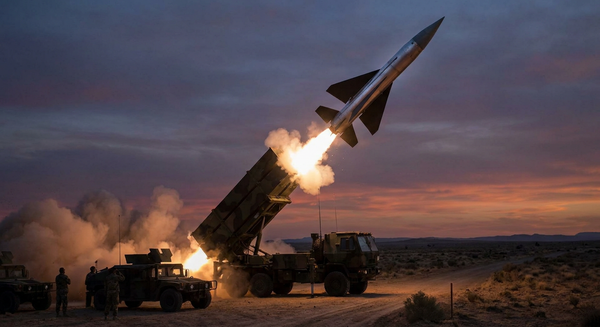
Lockheed Taps Detroit's Assembly Lines to Break the Patriot Interceptor Bottleneck
GM Defense turned the first PAC-3 MSE housing parts in 22 days, work aerospace shops often take months or years to finish. The run is the first timed test of Lockheed's bet that Detroit can unstick the Patriot interceptor line.

On September 17, Lockheed Martin announced that GM Defense had turned the first structural housing components for PAC-3 MSE Patriot interceptors in 22 days. The companies signed a contract on August 6. The parts arrived August 28. Housings of this type are precision-machined metal that aerospace tier-2 suppliers have historically taken months, and in some cases years, to produce.
The clock is the story because the shortage sits in the missile, not the battery. Conflicts in Ukraine and the Middle East have driven a surge in demand for Patriot air defense batteries and PAC-3 MSE interceptors. The Pentagon has asked Lockheed Martin to triple PAC-3 MSE production and quadruple THAAD output over the next several years. Traditional aerospace machining has not shown it can absorb that step-change, which is why Lockheed went to Detroit.
The Department of Defense had already pressed the company to recruit non-traditional manufacturers. On June 16, at the Reindustrialize Summit in Detroit, Lockheed Martin and General Motors signed a memorandum of agreement. The August housing run is the first timed result: automotive casting and precision machining, applied to a Patriot interceptor part.
Twenty-two days on a part that used to wait
The work GM Defense took on is unglamorous and load-bearing. Structural housings are not seekers or rocket motors. They are the metal envelope that has to hold tolerance so the rest of the missile can be stacked, tested, and shipped. When those pieces queue for months at a tier-2 aerospace shop, finished interceptors do not leave the factory, no matter how much capital Lockheed puts into final assembly.
That is the industrial logic behind the 22-day clock. Tim Cahill, president of Lockheed Martin Missiles and Fire Control, said the delivery shows commercial manufacturing can merge with defense supply chains. Stephen duMont, president and CEO of GM Defense, pointed to the parent company's precision fabrication and its habit of making the same part, to the same spec, at volume. Neither claim is a production-rate forecast. It is a first-article result on one class of component. One 22-day batch does not triple PAC-3 MSE output overnight, but it shows that scarce aerospace machining can be tackled with a different industrial toolkit.
Why the Pentagon sent Lockheed to Detroit
The June memorandum was not a one-off photo line. Pentagon demand for interceptors had already outrun the usual vendor list, which is why Defense News reported the first GM parts against a backdrop of Ukraine and Middle East consumption. The services want rate. Aerospace machine shops have calendars. The Pentagon's instruction to Lockheed was to look outside that calendar.
Lockheed Martin chief operating officer Frank St. John has drawn a straight line from a Corvette to a THAAD interceptor. Both are highly engineered, precision manufactured, sit on diverse supply chains, and have to be built at rate. The analogy is useful only if Detroit's rate culture survives the transfer onto high-tolerance missile work.
GM Defense vice president of strategy Bruce Brown noted the initial focus is munitions, though it will not stay there exclusively. That is the right way to read the PAC-3 MSE housing delivery. It is a munitions proof point, not a promise that GM will become a second source for every Lockheed missile. The test is whether automotive process control, casting, and machining can be repeated on subsequent production lots without first-article cycle inflation.
Capital is already moving, ahead of the rate
Lockheed is not waiting for Detroit to solve the whole problem. The company is putting $8 billion to $9 billion of capital into munitions output, covering PAC-3 MSE, THAAD, and PrSM, adding buildings and jobs at more than 20 U.S. sites and expanding production and warehouse space by nearly 50 percent. That spend buys floor space, tooling, and inventory. It does not, by itself, create more qualified housing suppliers.
General Motors is spending $7 billion in capital investment and $9 billion in research and development across its commercial and defense operations. Those figures explain why Lockheed went looking in Detroit rather than standing up a greenfield machine shop of its own. The tooling, the quality systems, and the workforce that already cut metal at automotive tempo are already operational.
If the partnership holds, Patriot and THAAD rates become a function of who can machine structural metal on a defense clock. Aerospace tier-2 shops still own most of that work, and their order books are full. A 22-day housing delivery from GM Defense is evidence that a second industrial base can be qualified for critical PAC-3 MSE parts.
The announcement does not disclose how many housings were in the first batch, whether GM Defense is a surge supplier or a permanent second source, or how lot acceptance will look at scale. Until those answers show up in subsequent deliveries, the Patriot interceptor bottleneck is not broken. It has a new address in Detroit, and a clock that, once, ran to 22 days.