Missile-Tracking Satellites Can't Talk to SpaceX's Network. The Fix Could Cost $1 Billion
SpaceX's $2.29 billion space data network cannot talk to SDA and SSC missile-tracking satellites. The Space Force is buying translator spacecraft, and sources say the overhaul could reach $1 billion.
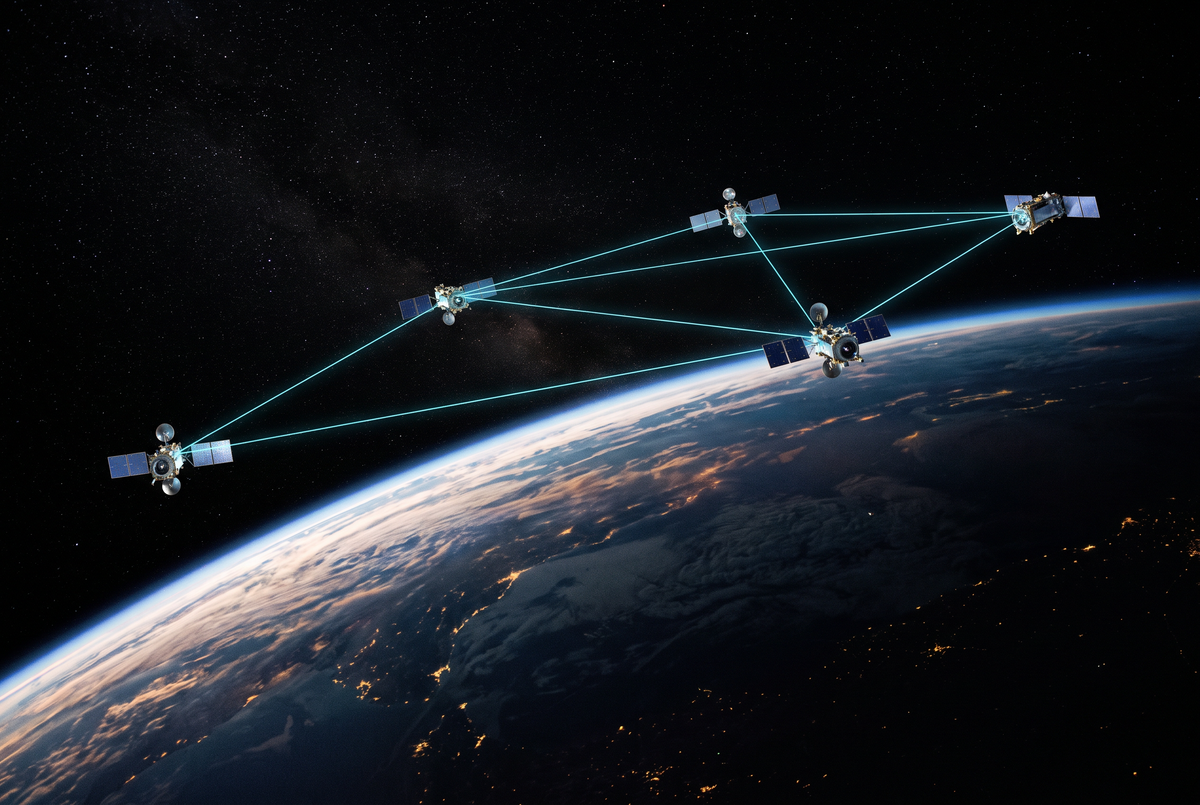
The Pentagon's space-based missile-warning architecture has a connectivity problem it created for itself. The laser terminals on SpaceX's new data-transport constellation cannot exchange data with the terminals on Space Development Agency and Space Systems Command missile-tracking satellites, and those two tracking fleets cannot talk to each other either, according to a Nov. 6 Breaking Defense report citing industry, former-government, and current Space Force sources.
An SDA official confirmed on the record: "The optical waveform/terminals on SDA's Transport Layer and Tracking Layer satellites, which carry the SDA OCT Standard, are not directly compatible with the Plaser waveform." Plasers are what SpaceX calls the optical terminals on its Space Data Network Backbone satellites.
That Backbone was meant to be the space-based data backhaul connecting sensors to shooters, including support for the Trump administration's Golden Dome missile defense initiative and its 2028 deadline. The Space Force is now buying translator spacecraft, Space Exchange Points, to stitch the networks together. Sources said the overall cost of the wider overhaul could reach up to $1 billion.
A mesh that cannot reach the trackers
SpaceX won a $2.29 billion Firm-Fixed-Price Other Transaction Authority delivery order to build the SDN Backbone, announced May 26, 2026. The award requires a fully operational prototype capability by the end of 2027. The Backbone is a proliferated low-Earth-orbit constellation, an optically interconnected mesh providing high-capacity, low-latency data transport, and it works alongside SDA's Transport Layer.
In the near term it is supposed to connect to SDA's Tracking Layer satellites in low Earth orbit, for detecting and tracking missiles, and to Space Systems Command's Resilient Missile Warning and Tracking satellites in medium Earth orbit. Those Plasers cannot directly exchange data with the terminals on the SDA and SSC missile warning and tracking satellites. The SDA and SSC terminals are also incompatible with each other.
A 2025 switch split the optical standards
The incompatibility stems partly from a decision around 2025 by the Department of the Air Force to switch the SDN backbone from SDA's Transport Layer to SpaceX's constellation, then called MILNET and already in use by the National Reconnaissance Office. After that shift, the department was left with two missile-tracking constellations and a SpaceX data backbone built on incompatible laser-communication standards.
SDA's Transport Layer and Tracking Layer satellites carry the SDA OCT Standard. SpaceX's Plasers do not. Closing the sensor-to-shooter path now depends on an extra hop in orbit.
Orbital routers as the patch
On Aug. 13, 2026, Space Systems Command awarded "$12 million per set" to five companies to prototype multi-vendor interconnection with the SDN Backbone and to seed Space Exchange Point satellites. The five companies are Amazon LEO for Government, Lockheed Martin, Northrop Grumman, Rocket Lab, and York Space Systems. SEP satellites are specialized spacecraft that act as orbital routers, allowing disparate networks and government satellite systems to connect directly to the SDN Backbone. The same announcement references the Enterprise Space Terminal program, which designed optical terminals utilizing a government-owned communications standard suitable for low-Earth orbit to geostationary Earth orbit connectivity.
The Space Force is considering a constellation of 12 to 13 additional SEP translator satellites from that work, expected to cost roughly $12 million to $14 million each, making the satellite project itself north of $100 million, according to the sources. Those figures are not Pentagon-confirmed totals. Even if the 12 to 13 spacecraft stay in that band, sources said the wider overhaul could reach up to $1 billion.
Golden Dome's 2028 clock
The operational pressure is the Golden Dome timeline. The SDN is meant to move tracks from the low-Earth-orbit Tracking Layer and the medium-Earth-orbit warning satellites to shooters against a 2028 deadline. A fully operational Backbone prototype is due by the end of 2027.
The interoperability problem sits inside a network that was supposed to be Golden Dome's sensor-to-shooter backbone: two tracking fleets and a $2.29 billion SpaceX mesh that cannot talk, now bridged by SEP routers whose wider fix, sources said, could reach $1 billion. How many translator satellites fly, what they cost, and whether they restore a working path before 2028 is still developing.