Northrop Rebuilt Its Loyal Wingman on Its Own Dime to Reenter the Air Force's Drone Race
YFQ-48A Talon Blue flew itself end to end at Mojave, 15 months after the aircraft was conceived. Northrop is betting a self-funded demonstrator can win what its pricey Increment 1 bid could not.
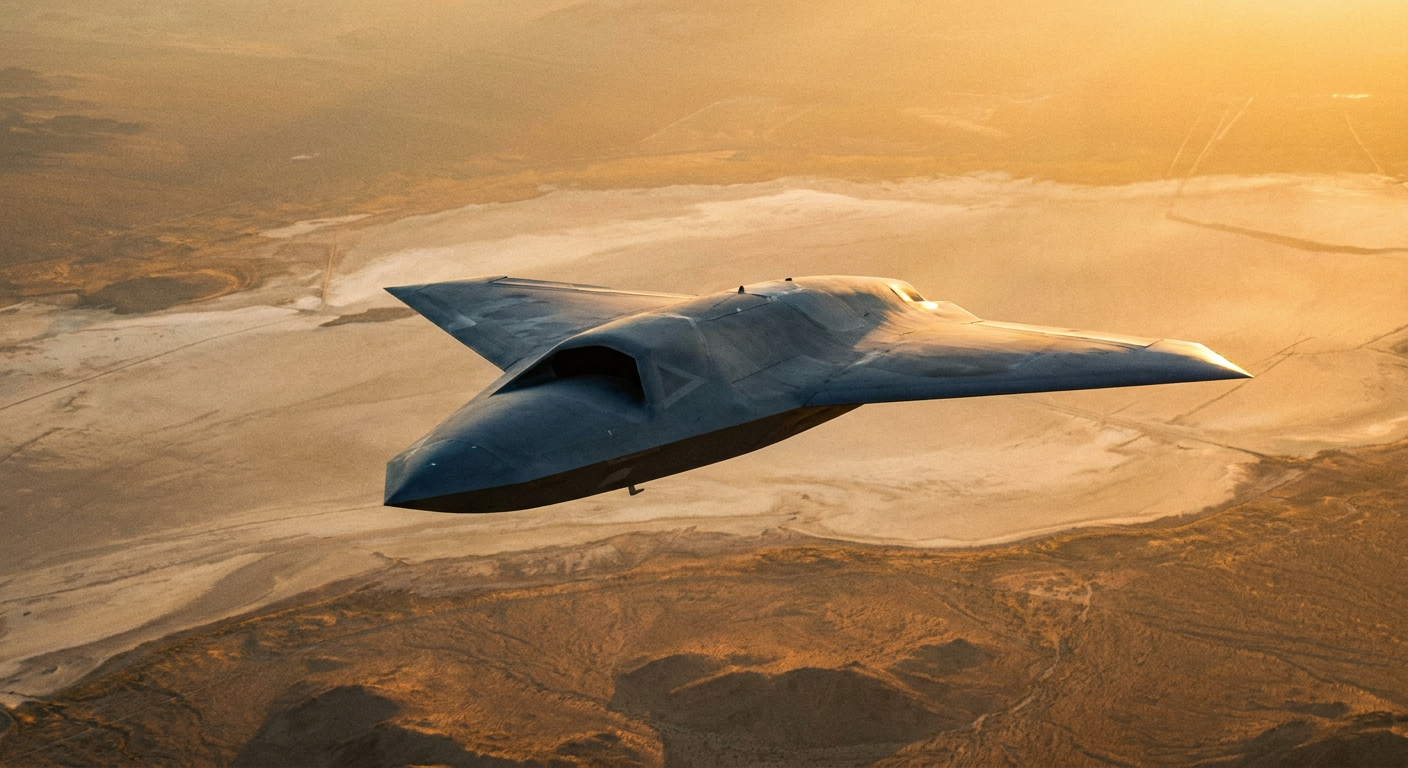
Northrop Grumman's (NYSE: NOC) YFQ-48A Talon Blue completed its first fully autonomous flight on October 3, 2026, from the Mojave Air & Space Port in Mojave, California. The sortie is the public debut of a company-funded collaborative combat aircraft that Northrop is using to reenter a U.S. Air Force competition it lost in 2024.
Flight-tracking data under civil registration N444LX showed the jet running several circuits over the surrounding test area before returning to the airport, according to trade reporting. The sortie demonstrated fully autonomous taxi, takeoff, in-flight maneuvers, and landing. Those four legs of the profile matter as much as the airframe itself. The Air Force wants uncrewed wingmen that can operate without a safety pilot in the loop from the first takeoff roll through recovery.
A company-funded recovery after Increment 1
In 2024, the Air Force eliminated Northrop from Collaborative Combat Aircraft Increment 1, awarding contracts to General Atomics for the YFQ-42A Dark Merlin and to Anduril Industries for the YFQ-44A Fury. Tom Jones, president of Northrop Grumman Aeronautics Systems, later acknowledged that the original Increment 1 proposal was too expensive and too complex for the service's affordable mass goals.
That admission framed the industrial problem. Increment 1 selected vendors the Air Force judged able to produce large numbers of aircraft at a price the fighter force could absorb. Northrop, a historic prime on stealth airframes, found itself outside the first production path. The company responded with Project Talon, an entirely company-funded initiative completed by Scaled Composites, its Mojave-based subsidiary known for rapid aircraft prototyping and advanced composites.
The team conceived the aircraft and reached "weight on wheels" in roughly 15 months. That timeline is the point of handing the work to Scaled Composites rather than a conventional production plant. The Air Force assigned the official Department of Defense Mission Design Series designation YFQ-48A in December 2025, according to later analysis. The YFQ prefix places Talon Blue in the same experimental fighter-drone series as the Increment 1 aircraft even though Northrop is paying the development bill.
Fewer parts, a weapons bay, and Prism autonomy
Talon Blue uses a modular composite design that achieves a 50% reduction in part count compared with traditional manufacturing and weighs approximately 1,000 pounds less than previous iterations, according to Northrop's own description of the aircraft. Visible features include a high dorsal air intake, a wide wheelbase, an integrated internal weapons bay, and low-observable shaping reminiscent of Northrop's historic Tacit Blue demonstrator.
The internal bay is the operational tell. An aircraft built only as a sensor truck can still be useful, but an internal store station is how Northrop is arguing that Talon Blue can fly as a combat teammate rather than a trailing drone. Low-observable shaping, including the Tacit Blue echo in the planform, is the company's attempt to keep that payload inside a signature that can operate near crewed fighters.
Mission software is Northrop's Prism Mission Autonomy suite, previously tested on the Talon IQ testbed flying on the Scaled Composites Model 437 aircraft. The first Talon Blue flight therefore combines a new airframe with autonomy code that had already been flown on another Scaled Composites jet. That split (airframe at Mojave, software already on a testbed) is how Northrop compressed the path from concept to a fully autonomous first sortie.
Increment 2 and a crowded field
The Air Force plans to field at least 500 collaborative combat aircraft by 2032 to fly alongside crewed fighters, including the F-35 and Next Generation Air Dominance. The service is now defining requirements for CCA Increment 2. Gen. Dale White, director of critical major weapon systems, noted that those requirements will span varying theater needs across the Indo-Pacific, EUCOM, and CENTCOM.
That geographic spread is the opening Northrop is trying to exploit. Increment 1 locked in two vendors. Increment 2 is still being written, and White's comment implies the next buy may not be a single design optimized for one theater. Range, signature, and payload needs can differ between the Pacific and shorter-range European or Middle Eastern fights. A company-funded demonstrator that has already taxied, flown, and landed on its own is Northrop's bid to be in that conversation.
The competitive field already includes General Atomics' YFQ-42A, Anduril's YFQ-44A, Lockheed Martin's Vectis, Boeing's MQ-28 Ghost Bat, Kratos' XQ-58 Valkyrie, and allied efforts such as the UK/BAE Systems Brontanax. Northrop is positioning Talon Blue for Air Force Increment 2, other U.S. service branches, and international allied air forces.
Northrop still sits outside the Increment 1 production path. With Talon Blue now through first flight, the company is offering a flying, self-funded demonstrator as the Air Force shapes the next round of requirements, other service needs, and allied demand. The October 3 profile from Mojave does not restore the Increment 1 award, but it puts a YFQ-48A on the board before Increment 2 requirements harden.