Parsons' Government Contracts Are Piling Up Just Weeks After a Rough Quarter
Parsons has landed seven new contract awards and positions since August 11 across missile defense, space, cyber, and electronic warfare. Three weeks earlier, the company told investors its national security segment had posted a quarterly loss.

Parsons Corporation has picked up seven new contract awards and positions in the past two weeks, spanning missile defense, space, cyber, and electronic warfare. The run comes just three weeks after the company told investors its national security business had posted a quarterly loss, a reminder that a rough set of headline numbers doesn't always mean government customers are pulling back.
A two-week run across five customers
The streak opened on August 11, when the Army awarded Parsons a $40 million contract to develop next-generation electromagnetic warfare capabilities, new work for the company built around a base year and four and a half option years. Two days later, the Air Force added a $70 million task order under its Air Base Air Defense program, sending Parsons to integrate and field point-defense systems across the USAFE-AFAFRICA theater.
The pace picked up from there. On August 19 the Space Force named Parsons one of the awardees on its NITE-STAR contract, a multiple-award vehicle for space test and training capabilities with a combined $981 million ceiling split across everyone who won a spot on it. A day later, the Navy kept Parsons on as the incumbent for a $350 million contract supporting Naval Information Warfare Center Pacific's seabed-to-space intelligence, surveillance, and reconnaissance work.
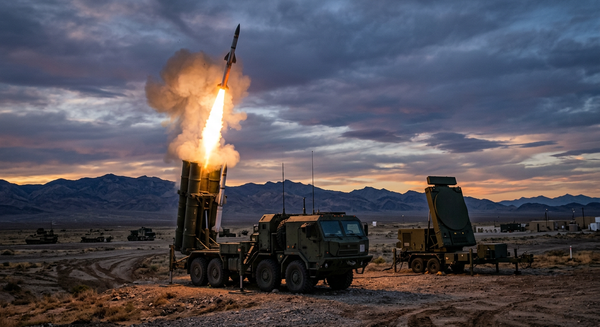
The Missile Defense Agency followed on August 24 with a $514 million option extending a missile-defense engineering partnership that Parsons says goes back more than four decades. The next day, U.S. Cyber Command handed SealingTech, a Parsons Corporation company, a $750 million sole-source award to move its Joint Cyber Hunt Kit into full-rate production. And on August 26, Parsons won a spot on COMET, a $14 billion intelligence-analysis vehicle supporting the Missile and Space Intelligence Center.
Not every number in that run belongs to Parsons alone. NITE-STAR's $981 million ceiling and COMET's $14 billion ceiling are both shared across every company that won a position on those contracts, and Parsons will still have to compete against the other awardees for individual task orders under each one. The MDA option, the SealingTech production award, the Navy ISR contract, the Air Force task order, and the Army electronic warfare contract are more direct wins, closer to money the company can actually count on. Even with that caveat, seven awards or positions across five different customers in sixteen days is an unusually dense run for any single company.
A quarter that told a different story
Three weeks before the first of these awards landed, Parsons reported second quarter results that looked considerably less encouraging. Federal Solutions, the segment that houses the national security work behind this month's contracts, posted revenue of $761 million, down 6% from a year earlier, and adjusted EBITDA fell to a loss of $14 million from a $67 million profit in the same period last year. Parsons attributed $77 million of that swing to charges tied to programs it plans to divest. Even stripping those charges out, adjusted EBITDA in the segment still declined 5% to $64 million, with margin slipping slightly to 8.2% from 8.3%. Company-wide, Parsons swung to a net loss of $15 million for the quarter, and diluted earnings per share came in at negative 14 cents.
The same earnings report that carried those numbers also showed Federal Solutions bookings up 51% year over year, with the company's overall book-to-bill ratio at 1.2x, above 1.0x in both of its segments. Total backlog climbed to $9.3 billion, with $6.6 billion of that funded. Parsons has now kept its trailing-twelve-month book-to-bill at 1.0x or better in every quarter since it went public in 2019.
What connects the two
Read together, the quarter and the two weeks that followed it tell a fairly coherent story rather than a contradictory one. The Q2 charges were tied to specific programs Parsons has decided to exit and a joint venture writedown, not to a broader pullback in what its government customers want to buy from it. The August run is what that ongoing demand looks like in real time: in a single month, Parsons' Defense and Intelligence business, led by president Mike Kushin, has closed deals or won positions with the Army, the Air Force, the Space Force, the Navy, the Missile Defense Agency, Cyber Command, and the Defense Intelligence Enterprise.
Whether that translates into a better-looking income statement depends on how quickly the new backlog turns into billed work, and Parsons has not yet reported third-quarter results that would show whether it has.