Tekever Raises $580 Million at $6.4 Billion Valuation to Scale Autonomous Drone Fleets
Tekever closed a $580 million Series D at a $6.4 billion valuation, backing AR5 production for the British Army's Project CORVUS and a combat-proven European drone line.
Tekever announced the first close of a $580 million Series D on September 23, 2026, at a $6.4 billion valuation. UC Investments, the University of California endowment making its first direct investment in Europe under CIO Jagdeep Singh Bachher, and Baillie Gifford, with Investment Manager Chris Evdaimon on the deal, led the round. For a privately held unmanned aircraft maker founded in Portugal, long-duration institutional capital is treating European drone production as industrial infrastructure.
Strategic and participating investors include Merlyn Advisors, joined by former UK Defence Secretary Sir Ben Wallace as a portfolio manager, Crescent Cove under CIO Jun Hong Heng, Ventura Capital Managing Partner Mo El Husseiny, and Iberis Capital Partner Diogo Chalbert Santos. The raise follows a €70 million ($74 million) Series B in November 2024 led by Baillie Gifford and the NATO Innovation Fund. Tekever runs dual hubs in Lisbon and in Bristol and Swindon in the United Kingdom, with additional operations in France, Fayetteville, North Carolina, and Estonia.
The capital lands two months after the UK Ministry of Defence and Defence Equipment and Support selected Tekever's AR5 for Project CORVUS, the British Army's Land Tactical Deep Find surveillance program. That contract is worth up to £400 million over 10 years. It replaces the Thales/Elbit Watchkeeper fleet, in service since 2014, which has been dogged by reliability issues and is reaching the end of its life. The Series D is meant to turn a wartime-proven airframe into a production line that can fill a NATO army's deep-find gap on a clock measured in months.
Replacing Watchkeeper on a Combat Clock
Project CORVUS starts with an initial order of six AR5 aircraft, scaling to as many as 24 delivered by 2029 and built at Tekever's new Swindon production facility. The type is due to enter service in late 2026 with five years of initial support and options to extend. Separately, the UK National Armaments Director Group procured Tekever's AR3 for the Royal Air Force's StormShroud electronic warfare and surveillance capability. Together the awards put a Portuguese-founded manufacturer inside both a land deep-find mission and an RAF electronic warfare program.
Watchkeeper's retirement is the opening. The British Army needed a medium-altitude, medium-endurance replacement that could stay aloft long enough to find and track targets at range, and it chose a platform already flying in combat rather than another multiyear development cycle. Manufacturing in Swindon also ties the order to UK industrial output. The Ministry of Defence presented the award as new aircraft for soldiers and jobs in the South West of England and Wales.
Vertical Integration, Edge AI, and Hours in the Field
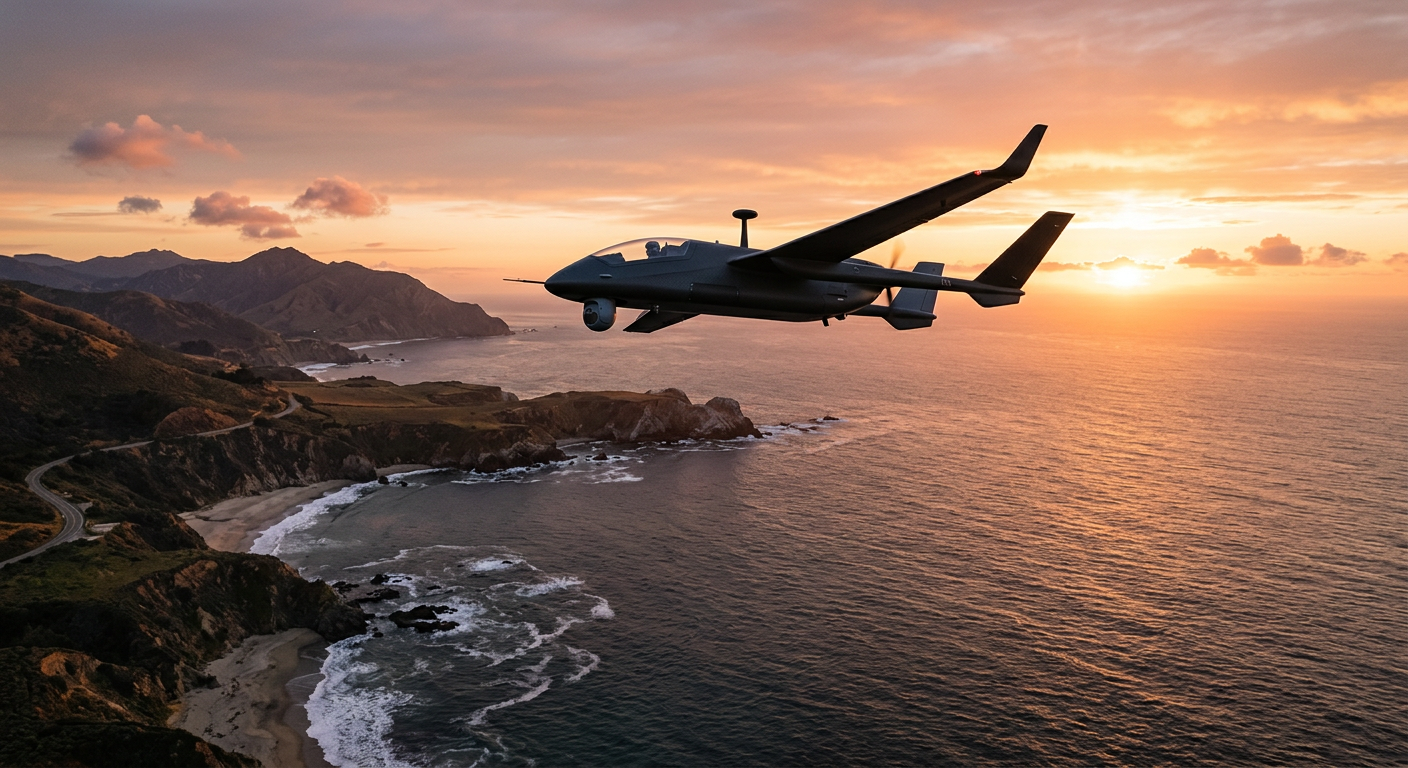
The AR5 is a medium-altitude, medium-endurance fixed-wing autonomous unmanned aircraft. It can fly for up to 20 hours and carry a payload of up to 50 kilograms, including electro-optical and infrared cameras, maritime search radar, synthetic aperture radar, satellite communications, and signals intelligence sensors, according to company specifications. The smaller AR3 and AR3 EVO are compact, modular tactical aircraft with vertical takeoff and landing. That mix lets Tekever sell both a deep-find workhorse and a runway-independent tactical node from the same industrial base.
The company is vertically integrated. It builds airframes, sensors, onboard AI edge compute, and satellite datalinks in-house, and it runs them through ATLAS, its mission management software for real-time sensor processing. That stack is already flying. Tekever systems are operational in Ukraine against Russian forces, on Channel maritime border surveillance for the UK Home Office, and on environmental and maritime patrol for the European Maritime Safety Agency. Combat hours in Ukraine are what long-duration investors can underwrite. Home Office and EMSA missions show the same airframes can also fly peacetime patrols.
Sovereign Capital at Prime Scale
A $6.4 billion valuation on a first close of $580 million is prime-scale money for a company that is still private. UC Investments' first direct European bet, Baillie Gifford's return after leading the 2024 Series B, and the NATO Innovation Fund's earlier participation all point the same way: European unmanned systems are being financed as strategic capacity. Sir Ben Wallace's role at Merlyn Advisors puts a former UK defence secretary on the cap table as Tekever takes over a British Army surveillance mission from Watchkeeper.
The constraint is industrial. Scaling from six AR5s on contract to 24 by 2029, while also feeding AR3s to StormShroud and sustaining aircraft already flying in Ukraine and over the Channel, is a factory problem. The Series D is sized to buy production capacity in Swindon and across Tekever's Lisbon-to-Bristol footprint, not to fund a paper design. Whether $580 million is enough will depend on how fast CORVUS ramps, and on whether other European armies follow the British Army in choosing a combat-proven medium-endurance aircraft over a stalled legacy program.