The Army Turned Counter-Drone Buying Into a $4 Billion Catalog
The Army and JIATF-401 awarded 10 firms $4.15 billion in counter-drone IDIQ ceilings, from gun turrets to jammers. Only $50 million is obligated so far, leaving the rest to Congress.
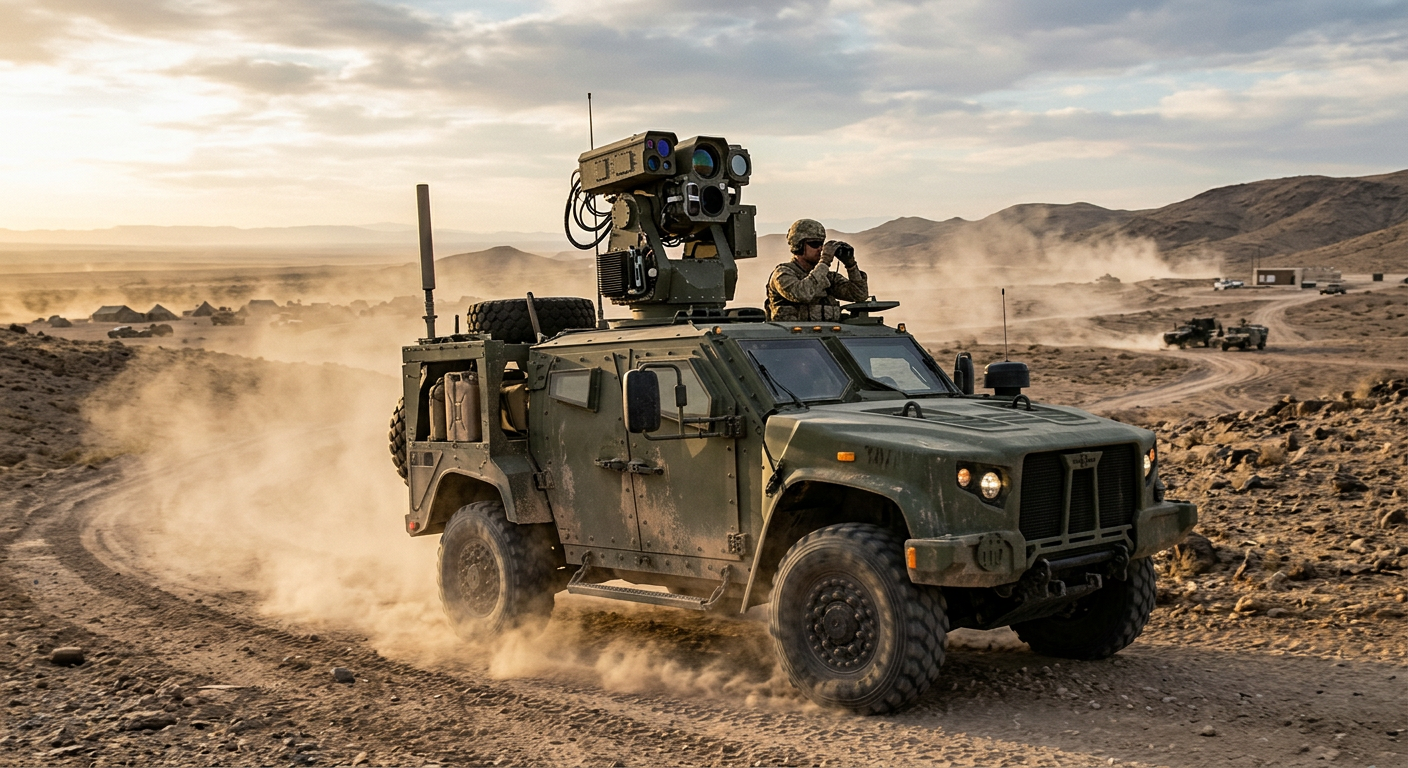
The U.S. Army and Joint Interagency Task Force 401 last week handed out counter-drone contracts to 10 companies under a combined ceiling of $4.15 billion, the latest step in the Pentagon's push to buy commercial anti-drone gear off the shelf at listed prices with the manufacturer already vetted. The awards, announced by Army Contracting Command at Detroit Arsenal together with JIATF-401, cover everything from tactical radar and electronic jammers to autonomous gun turrets.
The big ceiling, the small check
The headline number deserves a closer read. Across the 10 awards, only $50 million has actually been obligated so far, a figure JIATF-401 acquisition director Col. Tony Lindh confirmed. The remaining nearly $4.1 billion is ceiling: an upper limit that task orders and congressional appropriations could fill out through late September 2029 under the continuing resolution and the FY2027 defense budget. In other words, the government has established the contract vehicle before funding the volume.
That structure cuts both ways. Vendors get a durable, three-year demand signal without having to bid a fresh competition for every base, and companies can raise capital and build inventory ahead of orders, as Brig. Gen. Matt Ross, the task force's director, has said. Taxpayers, meanwhile, only pay when a task order actually lands. The risk shifts from buying the wrong product in bulk to simply underfunding the promise.
The tier list
Seven of the 10 winners carry $500 million ceilings. Allen Control Systems, of Austin, Texas, makes the Bullfrog, an autonomous optical machine gun turret that pairs computer vision with a kinetic effector. DroneShield's U.S. subsidiary in Warrenton, Virginia, brings radio-frequency sensing and electronic jammers, including its DroneSentry-X Mk2. RADA Technologies, a Leonardo DRS unit in Germantown, Maryland, supplies compact tactical radars, and SRC Inc. of Syracuse, New York, covers radar and electronic warfare. L3Harris WESCAM USA of Nashville, Tennessee, adds electro-optical and infrared sensor turrets. Digital Force Technologies of San Diego and the small business Napatree Technology of McLean, Virginia, round out the top tier.
Two firms landed $250 million ceilings: Echodyne of Kirkland, Washington, whose metamaterials-based electronically scanned radar fills the detection layer, and PVP Advanced EO Systems of Lake Forest, California, whose tracking cameras do the identification work. Smart Shooter, based in Herndon, Virginia, with an Israeli parent, took the $150 million slot with its SMASH fire-control sights, which bolt computerized precision onto standard rifles.
Read together, the tiers sketch a layered defense for defense installations: radar finds the aircraft, RF sensors classify it, cameras track it, and jammers, guns, or rifle sights engage it. The Army's acquisition lead, Brent Ingraham, has described the design intent as avoiding single-vendor lock-in across sensors, effectors, and command-and-control, which is why the awards are spread across 10 primes rather than concentrated in one integrator.
Catalog buying meets congressional math
The vehicle feeds the Pentagon's digital drone and counter-drone marketplaces, including drones.mil, and the Domestic Shield program. Instead of a multi-year development program, bases, interagency partners, and foreign allies can order vetted commercial hardware from a catalog. Speed is the product: the commercial counter-drone market iterates faster than traditional acquisition can review it, so the task force is essentially renting industry development cycles rather than funding its own.
Vendors such as DroneShield, whose subsidiary announced its award, are positioned to compete for task orders on short notice as requirements emerge. The broader numbers show how fast this lane has grown. JIATF-401 has now awarded more than $5 billion in counter-drone contracts overall, including earlier IDIQs worth roughly $500 million each to AeroVironment and CACI, and is on track toward a $7 billion program ceiling with additional awards expected before late October 2026, according to coverage of the announcements.
The open question is appropriations. A $4.15 billion ceiling converts to hardware only as Congress funds task orders, and the current continuing resolution gives the program continuity rather than expansion. If the budget clears, the catalog model gets its test in the open market. If it stalls, the biggest number on the page stays theoretical, and the winners keep the franchise while waiting on the revenue. Either way, the Pentagon has established how it wants to buy drone defense: not bespoke, but catalog.