The Navy's $90 Million Bet on Affordable Hypersonic Mass
The U.S. Navy awarded Castelion an $89,997,162 firm-fixed-price order to take Blackbeard to Early Operational Capability. The buy tests whether a Mach 5 strike weapon can be produced cheaply enough for the fleet to field it in numbers.
The U.S. Navy has put nearly $90 million behind a proposition most hypersonic programs never had to prove: a weapon only changes the fight if the fleet can buy it in numbers. On August 25, 2026, the service announced a firm-fixed-price order of $89,997,162 to Castelion Corp. to advance Blackbeard, the company's hypersonic strike weapon, to Early Operational Capability.
The order came from the Naval Air Warfare Center Aircraft Division at Lakehurst, New Jersey, as an uncompeted Small Business Innovation Research Phase III action under the topic "Low Cost Highly Manufacturable Long Range Strike Weapon Production." It covers engineering, technical, logistics, and manufacturing services supporting 50 EOC weapons, and it is meant to move Blackbeard onto an official Navy Program of Record.
Work will be performed in Torrance, California, and at Project Ranger in Rio Rancho and Sandoval County, New Mexico, with completion expected by August 2028.
Fifty rounds, and a path onto the books
The funding mix shows how the Navy is stitching new and leftover research dollars into a production-shaped effort. The award draws $50 million in fiscal 2026 Defense-Wide research, development, test, and evaluation funds, roughly $15.8 million in fiscal 2026 Navy RDT&E, and about $24.2 million in fiscal 2025 Navy RDT&E that expires at the end of the current fiscal year.
That money does not appear in isolation. In February 2026, the Navy selected Blackbeard as the first weapon candidate under its Multi-mission Affordable Capacity Effector program, known as MACE and structured inside the Precision Strike Weapons Development Program in the Navy RDT&E budget. Congress then increased MACE funding by more than $140 million in the fiscal 2026 defense appropriations act.
The EOC buy sits on a short, dense sequence of earlier work. In October 2025, the Army and Navy issued initial integration awards. In February 2026, the Navy followed with a $49.9 million contract for prototypes and flight testing at Point Mugu. In April 2026, a $105 million contract modification funded F/A-18E/F Super Hornet integration and testing in the U.S. Indo-Pacific Command area through January 2028. A May 2026 framework agreement set a target of 500 weapons a year. In June 2026, a $23.4 million delivery order covered 50 pre-production prototypes and 50 storage and shipping containers. The August award is the step that turns that prototype pipeline toward an early operational stock and, if the transition holds, a named program.
Cost as the requirement, not a talking point
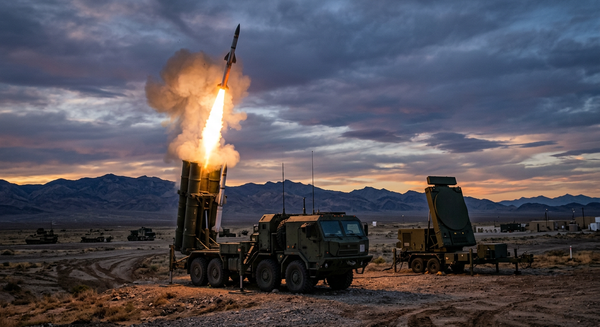
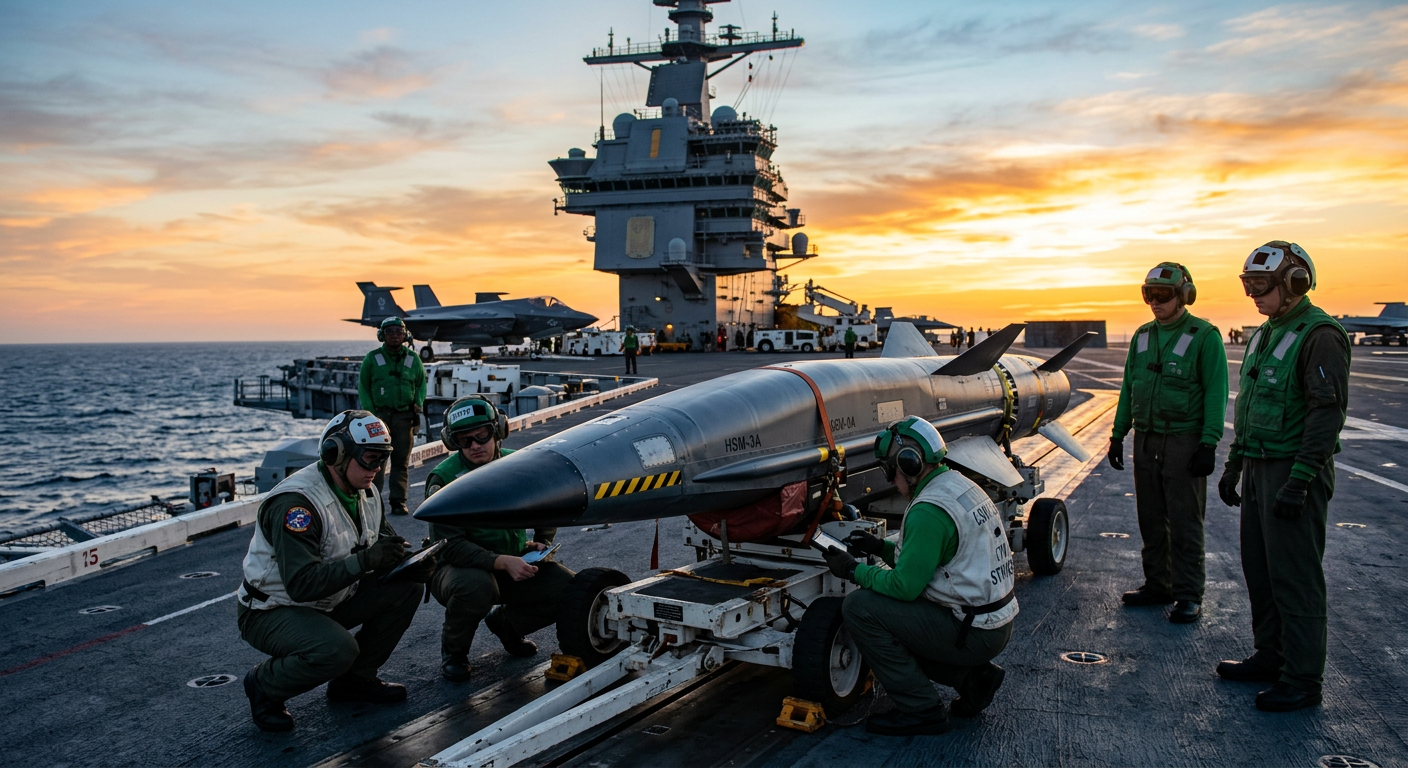
Blackbeard is specified to exceed Mach 5, with range up to 500 nautical miles, or about 800 kilometers. It is built for carrier aviation on the F/A-18E/F Super Hornet and for ground launch from HIMARS-compatible units. Those attributes matter. The attribute that distinguishes the effort from legacy exquisite hypersonic programs is price.
Castelion's unit cost target is under $500,000 per round. Legacy programs such as the Army's Long-Range Hypersonic Weapon and the Navy's Conventional Prompt Strike cost tens of millions per missile and can only be bought in small dozen-lot batches. If Blackbeard holds that cost target while clearing EOC, the Navy gets a hypersonic missile it can actually magazine, not a scarce round reserved for the opening hours of a war.
MACE's name is the doctrine in miniature: multi-mission, affordable, and built for capacity. A 500-weapon annual target only makes sense if combatant commanders can afford to expend the round. Fifty EOC weapons will not fill that magazine. They are the test article for whether the industrial story is real.
A Southwest factory, and export designed in
Castelion was founded in 2022 by former SpaceX engineers Bryon Hargis, Sean Pitt, and Andrew Kreitz. The company is headquartered in Torrance and manufactures at a 1,000-acre Project Ranger campus in Sandoval County and Rio Rancho, New Mexico. A recent $1 billion Series C funding round lines that campus up with a production bet rather than a briefing-room prototype.
The August award also includes funding for Defense Exportability Features design modifications, intended to accelerate export to U.S. allies and partners. That is a production decision as much as a diplomatic one. If Washington wants partners to field the same class of affordable long-range strike, the exportability work has to be in the design now, not added after the Navy's own line is frozen.
Read together, the Lakehurst order, the MACE plus-up, the Super Hornet and HIMARS paths, and the New Mexico campus are one argument. Hypersonic speed is no longer the scarce ingredient. Affordable capacity is. The Navy is paying Castelion $89,997,162, on a firm-fixed-price basis, to show that Blackbeard can be built, stored, flown, and eventually exported at a price that makes mass possible by August 2028.