Can Northrop's Record Backlog Outrun Its Fixed-Price Charges?
Northrop Grumman reports third-quarter results Tuesday with a record $104.7 billion backlog. Q2's fixed-price charges and a 6.3% tax rate make the margin print, not demand, the real test.
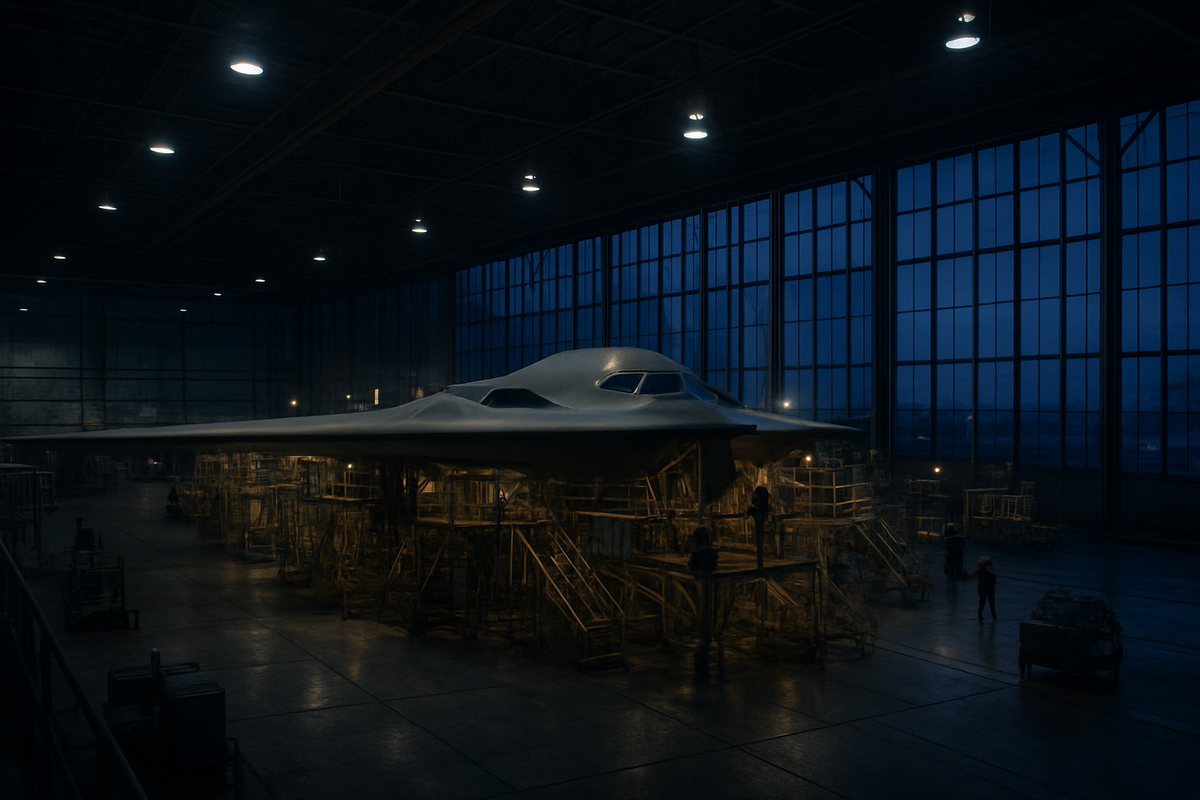
Northrop Grumman (NYSE: NOC) will release third-quarter 2026 results before the market opens on Tuesday, October 20, then host a 9:30 a.m. ET webcast. The company goes into the print with more booked work than it has ever carried, after a second quarter that raised full-year sales and earnings guidance even as the operating margin rate fell.
On July 21, Northrop reported second-quarter sales of $10.9 billion, up 5% from $10.4 billion a year earlier, with sales higher at all four sectors. Aeronautics rose 13%, driven by the B-21, restricted programs, the E-130J TACAMO ramp (a $106 million increase), and work on the B-2, F-35, and E-2. Net awards of $20.0 billion lifted backlog to $104.7 billion, a new company record that CEO Kathy Warden tied to robust global demand. The award tape was concentrated: $7.6 billion for Sentinel, $4.3 billion in restricted programs, $1.0 billion for the F-35, $0.8 billion for the Glide Phase Interceptor, and $0.7 billion for MESA. Management raised 2026 sales guidance to $43.75 billion to $44.25 billion, an increase of $250 million, and lifted MTM-adjusted EPS to $28.60 to $29.10, an increase of $1.20, while reaffirming operating income guidance and adjusted free cash flow of $3.1 billion to $3.5 billion.
That is a demand setup. The question for Tuesday is whether the second-half margin recovery management pointed to after those charges actually appears, because the same quarter carried two fresh fixed-price hits and a tax rate that flattered EPS.
What the backlog guarantees, and what it does not
A $104.7 billion backlog, swollen by Sentinel, restricted work, the Glide Phase Interceptor, and the B-21 ramp, is genuine revenue visibility. It does not, by itself, restore profit conversion. Second-quarter diluted EPS was $7.68 against $8.15 a year earlier, when the prior-year figure included a $150 million, or $1.04 per share, benefit from the training services divestiture. The operating margin rate was 10.1% versus 13.8%. Sales can keep compounding while the margin rate lags if fixed-price programs keep taking cost growth.
Published consensus estimates for the third quarter sit roughly at $7.18 to $7.22 EPS on about $11.1 billion of revenue. Those figures are analyst forecasts, not company guidance. Shares were trading near $500 as of mid-October, per market data in the same recap. Clearing the revenue number while the margin rate stays stuck would leave the second-half story unfinished, because the backlog has already done the work of explaining volume.
Why another fixed-price charge would matter
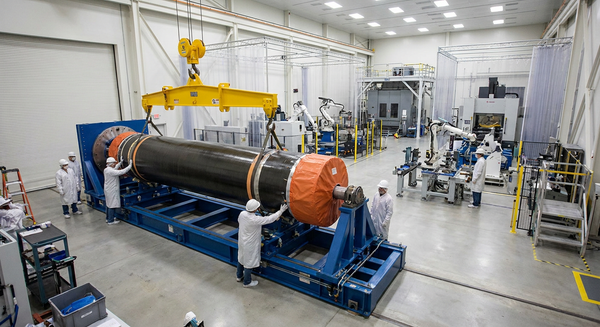
The July filing laid out two unfavorable estimate-at-completion adjustments. Defense Systems booked $68 million on the Stand-in Attack Weapon as the company invested to mature AARGM-ER production and develop and qualify SiAW. Space Systems booked $91 million on GEM 63XL from increases in projected cost to complete. Defense Systems margin fell to 7.5% from 12.7%, partly because the year-ago period included a $76 million favorable Sentinel adjustment that did not repeat.
Another round of that pattern in the third quarter would cut against the backlog narrative more than a miss on awards would. Sentinel and the Glide Phase Interceptor can keep the order book healthy. They cannot offset further cost growth on SiAW or GEM 63XL, or another Defense Systems margin compression, inside the operating line. Management expected improvement in the second half after the program charges. Tuesday is the first reported quarter in that window, so the SiAW and GEM 63XL EACs, and the Defense Systems margin rate, are the lines that test that expectation.
The tax-rate wrinkle that muddies EPS
Headline earnings comparisons from the second quarter are also messy for a reason that has nothing to do with B-21 or Sentinel. The effective tax rate was 6.3% versus 17.7% a year earlier, mainly from remeasurement of uncertain tax positions amid IRS developments. Net earnings were $1.1 billion. That low rate boosted EPS even as the operating margin rate compressed. If the third-quarter tax rate normalizes while charges persist, EPS can look weaker than the operating story. If the rate stays suppressed, EPS can look stronger than the programs underneath it. Either way, the quality of the print will sit in the margin rate, not the tax line, and last quarter's $7.68 is a poor base for a clean year-over-year read.
What would settle the debate Tuesday
The debate is not whether Northrop still has demand. The record backlog and the July guidance raise already answered that. What would settle it is evidence that second-half operating margin is recovering, that the SiAW and GEM 63XL estimates are not still moving against the company, and that adjusted free cash flow remains on the $3.1 billion to $3.5 billion path that was reaffirmed in July.
If the margin rate firms and guidance holds, the $104.7 billion backlog starts to look like earnings power rather than just booked work. If another fixed-price charge shows up, that backlog will still be there, and the conversion question will follow the company into the fourth quarter.