The Army Is Collapsing Its Missile Launchers Down to Three Robotic Chassis
The Army is folding HIMARS, Patriot, Typhon, and MLRS into three cab-less robotic launchers. Medium is weeks from award, Light is racing to Australia, and Heavy is next for Dark Eagle.
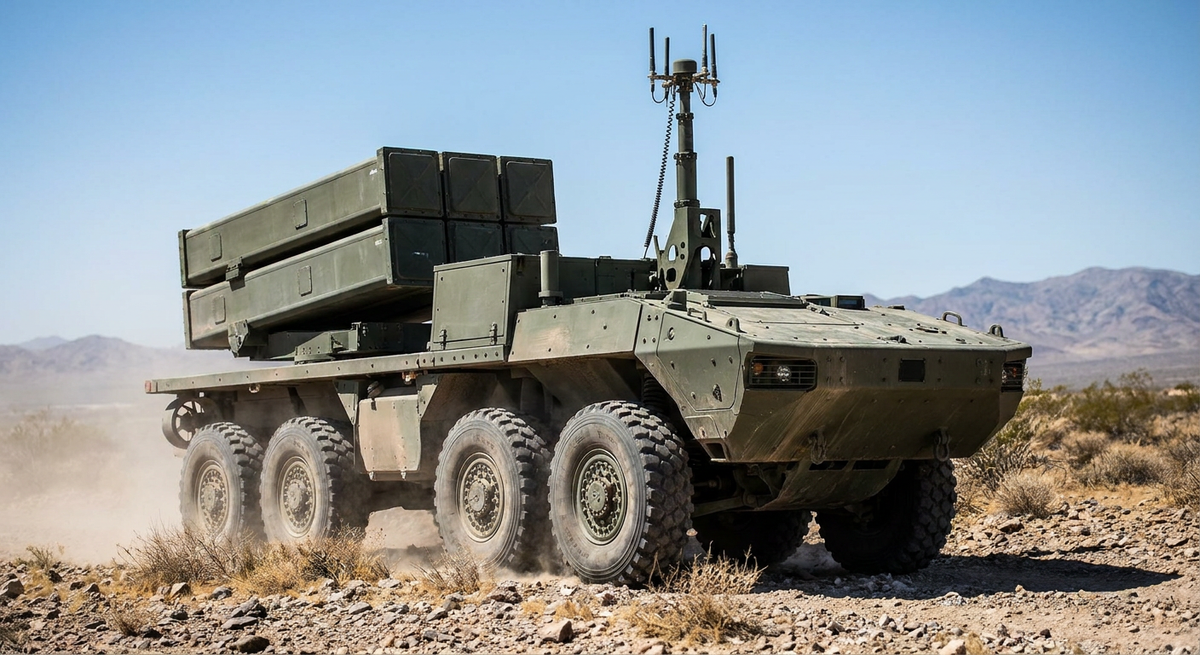
The U.S. Army has spent decades pairing nearly every missile and rocket with its own crewed launcher. HIMARS, the M270 MLRS, Typhon, and Patriot each rolled as a distinct vehicle, with a cab, a crew, a logistics tail, and a prime that owned the chassis as tightly as the munition.
At the AUSA 2026 conference in Washington, Lt. Gen. Frank Lozano, Program Acquisition Executive for Fires, announced that source selection for the Common Autonomous Multi-Domain Launcher Medium platform is finished. A platform contract award is expected within roughly 30 days, around mid-November 2026. Working through PAE Fires and the Rapid Capabilities and Critical Technologies Office, the service is consolidating its ground fires portfolio onto three standardized, cab-less robotic platforms: CAML Medium, CAML Light, and CAML Heavy.
The Medium line is already past the paper stage. In September 2026 the Army awarded up to $33.4 million to the Georgia Tech Research Institute to serve as weapon systems integrator for CAML Medium, splitting the integrator role from the platform vendor. Lozano explained that the Army originally considered a 60,000-pound gross vehicle weight platform, then dropped it after combatant commands judged the design too heavy and cumbersome for expeditionary deployments. The service capped CAML Medium at a 36,000-pound gross vehicle weight rating.
That weight cut is the operational argument. The same robotic truck is designed to carry mixed payloads, including Tomahawk cruise missiles, Patriot PAC-3 MSE interceptors, Precision Strike Missiles, MLRS rockets, and Indirect Fire Protection Capability interceptors. One chassis, several magazines, no cab.
From a stripped HIMARS to a three-class family
CAML grew out of the Autonomous Multi-Domain Launcher science and technology initiative, created in 2020 by DEVCOM Aviation & Missile Center and Ground Vehicle Systems Center. In live-fire tests at Yuma Proving Ground, engineers converted a manual HIMARS into an uncrewed, cab-less launcher that fits on a C-130 airlifter while tripling magazine depth or doubling munition capacity on the same transport footprint. That experiment is the template: strip the cab, pack more rounds, and stay inside the airlift envelope combatant commands actually use.
The Light variant is now on a compressed clock. On October 15, 2026, the Army released a Request for Solutions Brief for CAML-Lite, accelerating prototype awards to December 2026 from a previous spring 2027 target. The rush is a co-development push with Australia directed by Acting Army Chief Gen. Christopher LaNeve. Selected industry prototypes must be ready for a live-fire demonstration at Exercise Talisman Sabre in Australia in July/August 2027.
CAML Heavy sits further out, planned for the 2028-2029 timeframe, to carry larger strategic payloads such as the Long-Range Hypersonic Weapon, also known as Dark Eagle. Medium is the near-term workhorse. Light is the expeditionary, partnered sprint. Heavy is the strategic magazine once the service has a chassis for that class of missile.
Breaking the one-missile, one-truck buy
The industrial consequence is as important as the weight table. For years, primes tied specific missile programs to proprietary chassis. A HIMARS round traveled on a HIMARS truck. A Patriot interceptor sat on a Patriot launcher. That lock-in made software, autonomy, and hardware a single buy, and it made every new munition a new vehicle program.
By standardizing on three modular autonomous chassis and competing software, autonomy, and platform hardware separately, the Pentagon is building an open, distributed missile network, with the Indo-Pacific first island chain as the first theater. GTRI's integrator contract is the early signal that the weapon-system stack and the truck do not have to come from the same vendor. Platform source selection for Medium is a separate award. Light will bring in additional industry prototypes on an Australian timeline. Heavy, when it arrives, is meant to put Dark Eagle on a common robotic family rather than another one-off launcher.
Three clocks, one architecture
None of this is a finished fleet. Medium still needs the platform contract. Light still needs prototypes that can fire at Talisman Sabre. Heavy is a 2028-2029 plan, not a vehicle on a ramp. The 36,000-pound cap also means Medium will not carry everything, which is why Heavy exists. The Army's case is that three cab-less classes can absorb HIMARS, MLRS, Typhon, Patriot, IFPC, Tomahawk, PrSM, and eventually LRHW without a new crewed truck for each round.
If that holds, the first island chain gets more magazines per C-130 sortie and launchers that do not need a cab. The industrial base gets a chassis market no longer captive to a single missile program. The hard part is integration: mixed payloads on a 36,000-pound robot, autonomy and software competed apart from the platform, and a live-fire date in Australia already pulled forward from spring 2027. Lozano's 30-day clock on Medium is the first test of whether the Army can buy launchers the way it now wants to field them.