How the Army's Modular Software Shift Cut Artillery Timelines by 90%
The Army is splitting C2 into a shared data layer and a commercial app store. Ivy Mass cut artillery fire-mission timelines by 90 percent as NGC2 scales to I Corps.
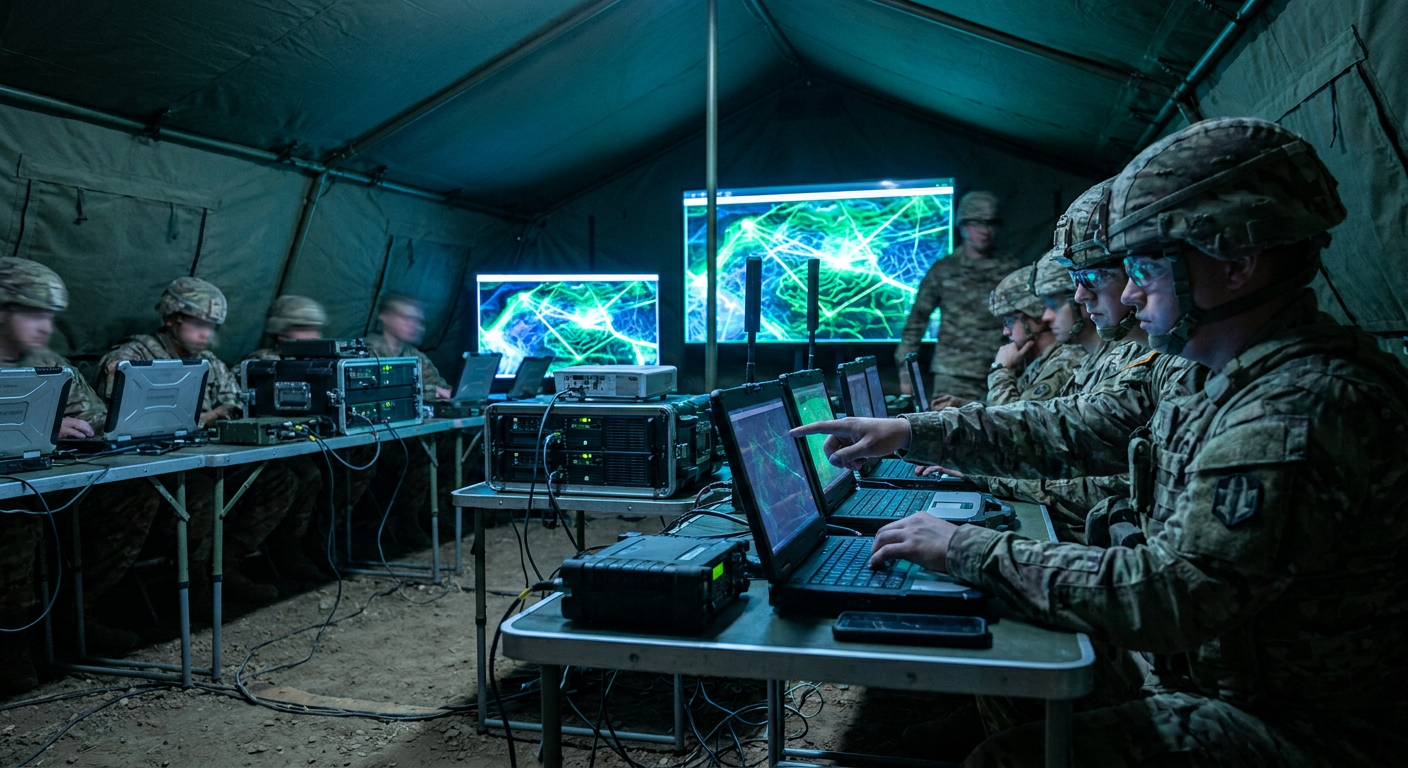
The U.S. Army spent decades buying command and control as a sealed product. Fire-control stacks such as AFATDS and intelligence systems such as DCGS-A were built by single primes, updated on multiyear cycles, and stored data in proprietary silos that neighboring applications could not easily share. Next Generation Command and Control, now moving from prototype to corps scale, unbundles that model. A common data layer sits underneath. Commercial applications plug in above it. The payoff showed up in live fire timelines.
On October 14, 2026, the Army issued initial contract awards totaling approximately $93.6 million across nine commercial software vendors for NGC2 warfighting applications. The vendors are General Dynamics Mission Systems, Air Space Intelligence Federal, Immersive Wisdom, LMI, Mente Systems, Stilman Advanced Strategies, Onebrief, Rune Technologies, and AIR. Those awards sit on top of a data and AI backbone already in motion.
A Shared Data Layer, Then the Apps
The architectural split is the story. The applications run on a common data baseline and AI backbone delivered by Anduril Industries using its Lattice operating system, plus Palantir Technologies, Raft, and Striveworks. Anduril's piece is a five-year contract awarded September 30, 2026, with an initial base period of $162.8 million and options that can scale total value up to $1.8 billion to deliver the common data layer baseline for NGC2.
That separation lets the Army treat C2 software like a managed marketplace rather than a single program of record. The modular app ecosystem is meant to integrate across six warfighting functions: C2, fires, intelligence, movement and maneuver, sustainment, and protection. Vendors compete on applications. The data layer stays shared. Joseph Welch, portfolio acquisition executive for C2/Counter C2, said providing core software applications is a critical next step that creates a foundation that can be rapidly scaled and trained across the force.
Ivy Mass and a 90 Percent Cut
The Army prototyped NGC2 over the past year with I Corps' 4th Infantry Division and 25th Infantry Division, including the Ivy Sting and Ivy Mass exercises. It also tested the architecture with 10,000 joint and allied participants and 90 technologies at Project Convergence Capstone 6 at Fort Irwin, California.
Ivy Mass is the metric operators will remember. Running across over 2,500 end-user devices, 160 tactical edge computers, and 40 warfighting apps, NGC2 reduced artillery fire mission timelines by 90 percent compared to legacy systems, while operating through degraded communications and simulated electronic warfare. Former Army Secretary Dan Driscoll framed the stakes in speed. The decisive advantage, he said, is sensing a target, processing data, and delivering a kinetic effect the fastest.
I Corps and the Pacific Problem
The Army is now scaling NGC2 to full corps-level deployment with I Corps in the Indo-Pacific theater, where units operate across thousands of miles of ocean with contested, intermittent communications. That geography is why the architecture was exercised under degraded comms and simulated electronic warfare rather than on a clean lab network.
Brig. Gen. Shane Taylor, portfolio management executive for Command and Control Information Network, said the Army is providing a deployed capability today while setting a blueprint for how industry integrates with speed and interoperability. I Corps is the first real customer of that blueprint. Island chains, long-range fires, and intermittent satellite links punish monolithic systems that assume a stable network. An app-store model that can run at the edge, on 160 tactical computers and thousands of end-user devices, is the Army's answer.
Primes, Startups, and MOSA
For traditional primes, the application awards are a mixed signal. General Dynamics Mission Systems is on the vendor list, but so are firms that did not sit at the center of legacy C2 franchises. The larger check, Anduril's $162.8 million base with a path to $1.8 billion, went to the data layer, not a traditional fire-control program. Palantir, Raft, and Striveworks sit in that same foundation tier.
Modular Open Systems Architecture and commercial other-transaction contracting are doing what decade-long defense IT programs often failed to do: ship software, measure it in exercises, then buy more of what worked. The Army is buying a shared data plane and letting vendors ship apps against six warfighting functions, rather than rebuilding AFATDS as a prettier sealed stack.
The risk is integration at corps scale. Forty apps on 2,500 devices in an exercise is not the same as I Corps stretched across the Pacific. Training, cybersecurity, and version control will decide whether the 90 percent timeline gain survives contact with a real campaign. The architecture, though, is now funded, fielded in prototype form, and pointed at the theater where contested communications are the default, not the exception.