The Army Is Looking for High-Temperature Drone Magnets. Evolution Metals Already Makes Similar Grades. (NASDAQ: EMAT)
The U.S. Army is in the market for high-temperature drone magnets ahead of a January 2027 defense sourcing deadline. Evolution Metals & Technologies Corp. (NASDAQ: EMAT) already produces certified high-temperature grades from non-China metal.

The U.S. Army is in the market for the small, powerful magnets that make drone motors spin. China accounts for roughly 90% of global permanent-magnet production, and Washington has committed billions of dollars across critical-mineral and magnet supply chains to reduce that dependence. This week the Army took a concrete step: it posted a sources sought notice asking manufacturers to come forward if they can supply the magnets in question, with responses due October 28 and the possibility of multiple awards on the government's mind. It is market research, not an order: the Army is finding out who can actually make these parts before it decides how to buy them.
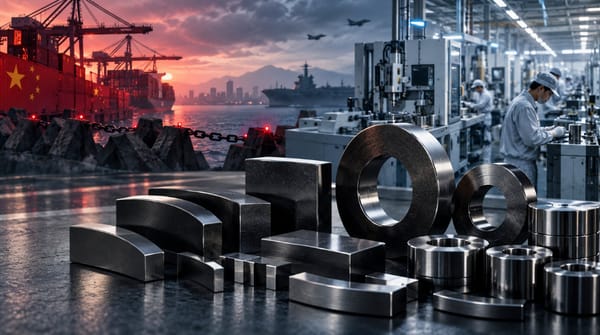
Evolution Metals & Technologies Corp. (Nasdaq: EMAT) is already commercially producing and selling sintered NdFeB magnets in the same high-temperature SH category. The critical-materials company runs commercial-scale production of sintered NdFeB magnets of the type used in high-performance electric motors at its facilities in Pohang, South Korea, and it says it has passed customer quality certification with two global Tier-1 electronics makers across six grades, including heat-resistant compositions that contain dysprosium, a rare earth China restricts. One honest caveat: the Army asks for grades that sit in the same category but are not identical to the company's certified list, and its certifications come from commercial customers, not defense ones.
The request, issued in coordination with Tobyhanna Army Depot, arrived as the depot's magnet sourcing for drones gathers pace. In September, the depot selected startup Vulcan Elements to supply magnets for SkyFoundry, the Army's push for stateside mass production of small drones. Vulcan's chief executive, John Maslin, told Axios his company won the work “because we're decoupled,” meaning its supply chain does not depend on China.
What the Army is buying
The Army's specifications call for 14 magnet segments in each of the brushless motors covered by the notice, in high-temperature grades shaped for three motor sizes, and it asks vendors to document where their rare earth materials are mined, refined, alloyed, magnetized and packaged. That transparency request is part of the Army's current market research and is distinct from a separate defense sourcing rule. That rule, DFARS 252.225-7052, extends restrictions on NdFeB magnets from China, Russia, Iran and North Korea across the supply chain from mining through finished magnets beginning January 1, 2027, subject to specified exceptions. The rule pushes covered defense procurement toward non-China material; the transparency requirement is how the Army proposes to see who can supply it.
Evolution Metals has been assembling pieces relevant to both standards. In June it announced the six-grade certification, covering grades from consumer-electronics temperatures up to the super-high-temperature, dysprosium-containing compositions used in demanding applications. In July it took delivery of its first shipment of neodymium-praseodymium metal produced entirely outside China, from SRE Vietnam under a purchase contract with Senri Trading Co., Ltd. (SRE Vietnam is a subsidiary of Japan's Tokai Trading), with deliveries the company expects to scale as production ramps. The company describes more than 18 years of commercial-scale magnet manufacturing, and it holds binding purchase orders for thirteen additional sintered magnet production machines from ULVAC, which the company characterizes as the world's leading producer of such equipment, scheduled for delivery and installation in November 2026. What the record does not yet show is heavy rare earth supply: the July delivery was NdPr, a light rare earth, and the company has not publicly detailed where it sources the dysprosium in its SH grades, a question both the Army's supply chain request and the 2027 rule reach.
The year the guidance describes
The company guided to $400 million to $460 million for fiscal 2027, against $5 million to $8 million expected for fiscal 2026. The guidance is built on the expansion now underway at Pohang: the thirteen machines scheduled to arrive in November, a power expansion from 130 megawatts to approximately 750 megawatts under agreed principal terms with Korea Electric Power Corporation, and adjacent land to be acquired from the Pohang city government. The company's own description of the year ahead is an execution checklist: install and commission the equipment, bring the power and facility expansion online, secure feedstock for higher volumes, complete customer qualifications, and convert demand into shipments. The guidance also rests on assumptions the company lists, including working capital, pricing and shipment timing, and its most recent quarterly report states that it expects to require additional capital. The company says the range “reflects anticipated utilization during the production ramp and does not represent the revenue potential of the planned capacity at full utilization.”
Whether the Army's survey turns into contracts, and for whom, is not yet knowable. What the record shows is that Evolution Metals is already producing magnets in the category the notice describes, while working to scale that production.
Recent News Highlights from Evolution Metals & Technologies Corp. (Nasdaq: EMAT)
Evolution Metals & Technologies Provides Initial Revenue Guidance of $400-460mm for Fiscal Year 2027
Read this Next >>
The Army Turned Counter-Drone Buying Into a Billion Catalog
Important Disclaimers and Disclosures: The author, Wall Street Wire, is a content and media technology platform that connects the market with under-the-radar companies. The platform operates a network of industry-focused media channels spanning finance, biopharma, cyber, AI, and additional sectors, delivering insights on both broader market developments and emerging or overlooked companies. Wall Street Wire is not a broker-dealer or investment adviser. References to market size estimates, valuations, price targets, or other third-party data are provided strictly for informational purposes. Wall Street Wire receives cash compensation from Evolution Metals & Technologies Corp. (the “Issuer”) for coverage and awareness services, which are provided on an ongoing subscription basis. The content above is a form of paid advertising and promotion and is for informational purposes only and does not constitute financial or investment advice. This article may contain forward-looking statements about the Issuer’s products, plans, or prospects that are subject to risks and uncertainties; actual results may differ materially, and readers should review the Issuer’s public filings on SEC EDGAR (sec.gov/edgar) for full risk factors. Market size figures, research estimates, or other third-party data referenced in this article are quoted from publicly available sources believed to be reliable; however, we do not independently verify or endorse them, and additional figures or estimates may exist. Full compensation details, information about the operator of Wall Street Wire, and the complete set of disclaimers and disclosures applicable to this content are available at: wallstwire.ai/disclosures. This article should not be considered an official communication of the Issuer. Images may be computer generated and are for entertainment and visualization purposes only, and may not be an accurate or exact depiction of the technology.